A friend just IM'd this notice on the death of Art Buchwald....
The man had an awesome life. He really took the whole bull of an experience by the horns and made his own rules....
Yet as I look over the particulars, I notice that this college drop-out, who had no formal journalism training other than working for an Army newspaper, was not only one of the finest writers of the 20th century, but also won a Pulitzer Prize....
And all I keep wondering: if "professional" journalism remains so hung up and depressed and angry at the world, will it be able to hear the voice of the next Art Buchwald?
Or will it be too busy pouring over the video resumes of top-noch spoon-fed J-school grads to bother to notice what might be roiling in the rabble?
I'd hazard a guess that the next Art Buchwald just might be noodling around with a blog right now...trying his (or her) hand at self-publishing because to do so is to play by one's own rules...
Maybe not just like Buchwald...no, those days are gone. But maybe a modern equivalent.
With Buchwald's death, we see not just the death of a great talent, but also, literally, the end of an era. Buchwald wrote by hand and on a typewriter. That's not how we do it now. Much more is expected--video, podcasts, writing. Would even a young Buchwald be able to master and keep up with the emerging demands of the e-journo landscape?
Maybe, but maybe not...
Think about it: if you're having to draw up storyboards for a video presentation, might you have the time to perfect a craft like satirical wit? Maybe--maybe not. If you're busy spending an hour or more simply editing and re-mixing a podcast, will you have time to develop your unique written voice? Maybe--maybe not.
And would Buchwald have been any better if he'd had all the gizmos, gadgets, and pods that we have nowadays. Maybe--maybe not.
They say "you can't take it with you." Depends on what it happens to be. Buchwald certainly is taking a certain it with him--an era in journalism and writing that is, perhaps, being buried under the weight of bad business and too much technology.
Say a small prayer for the passing of a great talent. And think about it....
Journalism media
Thursday, January 18, 2007


Tuesday, January 16, 2007
links 1/16/07
Censorship in Thailand...."Freedom of Information" only to those with university degrees (take heed, American citizen journalists)...Wikis could maybe change the fate of world politics?
From Bangkok Post: CNS media 'censorship' is a big mistake: Whatever the denial by the Council for National Security (CNS) chairman Sonthi Boonyaratkalin that he had nothing to do with the UBC pay television's ''censorship'' of former prime minister Thaksin Shinawatra's interview with CNN, the writing on the wall is too obvious to miss. always important to know what's going on in other parts of the world...
Republic of Tanzania: Proposed media bill most draconian, say stakeholders: The [media] stakeholders argue that making it mandatory for a person to have a university degree because he or she can practise journalism in the country would effectively mean that the media would no longer convey the voices of the ordinary people. When I listen to some U.S. journalists kvetch about citizen journalism, I think that they just might love a bill like the proposed Tanzanian "Freedom of Information Bill"
AOL looks to buy internet advertising firm TradeDoublerThe deal, which equates to $30.63 per share, was unanimously backed by TradeDoubler's board, although some shareholders believe the bid is too low.
From Joe at Techdirt: Can A Wiki Force Transparency On Oppressive Regimes? A new site called Wikileaks is offering a way for dissident government employees working under oppressive regimes to anonymously leak information on their government's behavior. The site, which is backed by proponents of ethical leaking, is chiefly targeting countries in Asia, the Middle East and Africa. Obviously, the idea of ethical leaking is open to debate, and some might argue that one individual should never get to decide what should and shouldn't be a state secret... In this country, maybe it's not the government, but the employees and stockholders of major corporations that should use wikis to expose corruption or as catalysts to change. Perhaps we would have avoided Enron if there'd been wikis--can't really *shred* a wiki, now, can you??
From Bangkok Post: CNS media 'censorship' is a big mistake: Whatever the denial by the Council for National Security (CNS) chairman Sonthi Boonyaratkalin that he had nothing to do with the UBC pay television's ''censorship'' of former prime minister Thaksin Shinawatra's interview with CNN, the writing on the wall is too obvious to miss. always important to know what's going on in other parts of the world...
Republic of Tanzania: Proposed media bill most draconian, say stakeholders: The [media] stakeholders argue that making it mandatory for a person to have a university degree because he or she can practise journalism in the country would effectively mean that the media would no longer convey the voices of the ordinary people. When I listen to some U.S. journalists kvetch about citizen journalism, I think that they just might love a bill like the proposed Tanzanian "Freedom of Information Bill"
AOL looks to buy internet advertising firm TradeDoublerThe deal, which equates to $30.63 per share, was unanimously backed by TradeDoubler's board, although some shareholders believe the bid is too low.
From Joe at Techdirt: Can A Wiki Force Transparency On Oppressive Regimes? A new site called Wikileaks is offering a way for dissident government employees working under oppressive regimes to anonymously leak information on their government's behavior. The site, which is backed by proponents of ethical leaking, is chiefly targeting countries in Asia, the Middle East and Africa. Obviously, the idea of ethical leaking is open to debate, and some might argue that one individual should never get to decide what should and shouldn't be a state secret... In this country, maybe it's not the government, but the employees and stockholders of major corporations that should use wikis to expose corruption or as catalysts to change. Perhaps we would have avoided Enron if there'd been wikis--can't really *shred* a wiki, now, can you??
Monday, January 15, 2007
links 1/15/07
Journalism sings "I will survive"...South African cit j. and ethics...The Giant makes Media tremble...little apps dying along the way...
Chris Peck on Journalism still vital in new world....Chris (who I met at the Media Giraffe conference) has some very important points in this statement about how journalism can remain vital in a new media landscape...
From South Africa: Citizen Journalism flexes its muscles...a Judge's drunkenness is captured on camera and a Rhodes University prof questions whether "civilian journalism comes with the ethics and morals which are ensured by mainstream journalism".
From MediaPost: Wal-Mart Picks Martin, MediaVest In Agency Re-Review The saga of Wal-Mart's advertising continues...
Greg Linden on Findory rides into the sunset...slowly...to possilby expire by benign neglect: Findory has been successful. Findory has influenced work at Google, Microsoft, AOL, and elsewhere. I am pleased with what Findory has accomplished. At some point, I have to declare victory and move on. I am moving on now, not to a new venture, but to spend more time on health and with family.
... Greg's right. (via Federated Media)
Chris Peck on Journalism still vital in new world....Chris (who I met at the Media Giraffe conference) has some very important points in this statement about how journalism can remain vital in a new media landscape...
From South Africa: Citizen Journalism flexes its muscles...a Judge's drunkenness is captured on camera and a Rhodes University prof questions whether "civilian journalism comes with the ethics and morals which are ensured by mainstream journalism".
From MediaPost: Wal-Mart Picks Martin, MediaVest In Agency Re-Review The saga of Wal-Mart's advertising continues...
Greg Linden on Findory rides into the sunset...slowly...to possilby expire by benign neglect: Findory has been successful. Findory has influenced work at Google, Microsoft, AOL, and elsewhere. I am pleased with what Findory has accomplished. At some point, I have to declare victory and move on. I am moving on now, not to a new venture, but to spend more time on health and with family.
... Greg's right. (via Federated Media)
AmericanTowns.com: Citizen Shovelware isn't Citizen Journalism
Update 2/20/10: apparently "citizen shovelware" won't die. See this new post on AOL/Patch.com's "hundreds" of pages idea Will3 yrs and AOL brand make a difference? I doubt it.
Update 9/12/07 Today I received a press release announcing Idearc Media Corp's $3.3m investment in AmericanTowns.com. That's nice. However, given that Idearc is a spinoff corp of Verizon, and Verizon is one of those big telcos that not only denies service to rural areas of W. Mass (under the excuse of lack of profitability) but also stands to gain from the anti-Net Neutrality, partitioning of services nonsense issued the other day by the U.S. Dept. of Justice--well...y'all can fill in the blanks re my opinion...
The New York Times doesn't quite get what citizen journalism is about: witness this piece that highlights a new piece of citizen shovelware called AmericanTowns.com (and completely doesn't get hyperlocal citizen journalism...as usual for msm...)
In an odd twist-of-software-building, AmericanTowns.com seems to mimic many of the features of Backfence.com(correction via a consultant friend: AT was first)--only differenct being AT has managed to have already put up sites for pretty much every town in the U.S. Apparently, AmericanTowns founders have that same sort of "if you build it, they will come," optimism that was part of Backfence. They've also had some success in one region of the U.S.--most notably Pleasantville, NJ--and believe that lightning will continue to strike in every single town across the country.
They've even rigged it so that you can see there are members in your town--just no more than the first 25 without having to register yourself. This is a sure-fire way of getting people to register, but no guarantee of participation.
I find it odd, too that the site's founders, Jim Maglione and Tom Panian, believe people will flock to their app to post stories just the way they do at WestportNow.com
The thing is, their app doesn't look like a citizen journalism site and doesn't have the sense of local community as Westportnow.com (or Baristanet.) AT.com looks like is what could be considered "citizen shovelware"--the basic message being "we want to be your town square! come shovel your content into our site and let us make some money off of ads!"
Some local papers that use Advance.com products want to be their geographic area's virtual town squares, too...but the success of those varies from place to place, with some place feeling nothing for the product, while others finding use for it during big emergencies (NOLA.com comes to mind.)
Although, when something that feels so corporate wants to be so hyperlocal, it just doesn't feel right...
A key component to the ideal of citizen journalism that Maglione and Panian don't appear to have considered is that there is an amazing spirit of indepedence and a strong sense of civic duty among citizen journalists--and that there are great pieces of cheap/free software out there for them build their sites. There really isn't much incentive for someone interested in citizen journalism to want to use M & P's app.
Even if the effort is kind of corporate, that it is hyperlocal corporate makes a difference. I'm thinking of BlufftonToday.com that has a very good community because of the type of paper it grew out of.
Yet another aspect of AT.com that's missing is that sense of virtual community and a community flavor that is so much a part of real hyperlocal citizen journalism sites. Sure, participants can register and post all sorts of information, but there's nothing that allows for comments--there are no blogs, no forums, etc. There are listings for attractions and there are even some photos of a local music event from someone's Flickr account (in Easthampton)--but there's no sense of life there. One of the biggest criticism levelled against Backfence.com in the recent weeks was that the sites seemed bland and lacking community. There doesn't seem to be too many ways one can build active community on AT either.
And even if there was, who would moderate it? Registration is a great start, but registation is no reason to put a site's community management on auto-pilot. Leaving comments in thin air does not make happy those who want to interact...
And what about AT.com's economic model? Looks right now to not only want to maximise GoogleAds, but also to take in local advertising, thus siphoning off more revenue from local media. Yet, from what I know about the local ad community's thinking, if there isn't a clear incentive, and a quick return, on their advertising, they're not going to go online for long. (I'm also reminded the following statment from Susan Mernit's recent post"Most of the really good--and viable--hyperlocal sites--are small businesses that serve a focused audience, with decent ad revenues but nothing like the big numbers VCs need for their $5 to $13 MM investments"
Further, I don't believe there's a one-size fits all citizen/community journalism model that's going to cash in, rake the big bucks, and put down every other citizen journalism project that's out there. Every community is different, and there are various levels of online participation in every communty. AT.com's cook it up, throw it against the wall and see what sticks model of citizen journalism may not be what inspires communities of people to participate. I can see from the Easthampton site that there may be some local musicians who might like its app, but that's not to say the same for Bozeman, MT or Kalamazoo, MI, or Searsport, ME or anyplace else on the map.
Yet only time will tell...
Note: I would consider Backfence to be a form of "citzen shovelware" also--have it on very good source that Backfence was modeled on , and wanted to outdo AT. However, it's not about outdoing AT, but coming up with a better model where people feel connected. IMO, neither provides that sense of connection to anything beyond a corporate mothership.
citizen journalism, media, web 2.0
Update 9/12/07 Today I received a press release announcing Idearc Media Corp's $3.3m investment in AmericanTowns.com. That's nice. However, given that Idearc is a spinoff corp of Verizon, and Verizon is one of those big telcos that not only denies service to rural areas of W. Mass (under the excuse of lack of profitability) but also stands to gain from the anti-Net Neutrality, partitioning of services nonsense issued the other day by the U.S. Dept. of Justice--well...y'all can fill in the blanks re my opinion...
The New York Times doesn't quite get what citizen journalism is about: witness this piece that highlights a new piece of citizen shovelware called AmericanTowns.com (and completely doesn't get hyperlocal citizen journalism...as usual for msm...)
In an odd twist-of-software-building, AmericanTowns.com seems to mimic many of the features of Backfence.com(correction via a consultant friend: AT was first)--only differenct being AT has managed to have already put up sites for pretty much every town in the U.S. Apparently, AmericanTowns founders have that same sort of "if you build it, they will come," optimism that was part of Backfence. They've also had some success in one region of the U.S.--most notably Pleasantville, NJ--and believe that lightning will continue to strike in every single town across the country.
They've even rigged it so that you can see there are members in your town--just no more than the first 25 without having to register yourself. This is a sure-fire way of getting people to register, but no guarantee of participation.
I find it odd, too that the site's founders, Jim Maglione and Tom Panian, believe people will flock to their app to post stories just the way they do at WestportNow.com
The thing is, their app doesn't look like a citizen journalism site and doesn't have the sense of local community as Westportnow.com (or Baristanet.) AT.com looks like is what could be considered "citizen shovelware"--the basic message being "we want to be your town square! come shovel your content into our site and let us make some money off of ads!"
Some local papers that use Advance.com products want to be their geographic area's virtual town squares, too...but the success of those varies from place to place, with some place feeling nothing for the product, while others finding use for it during big emergencies (NOLA.com comes to mind.)
Although, when something that feels so corporate wants to be so hyperlocal, it just doesn't feel right...
A key component to the ideal of citizen journalism that Maglione and Panian don't appear to have considered is that there is an amazing spirit of indepedence and a strong sense of civic duty among citizen journalists--and that there are great pieces of cheap/free software out there for them build their sites. There really isn't much incentive for someone interested in citizen journalism to want to use M & P's app.
Even if the effort is kind of corporate, that it is hyperlocal corporate makes a difference. I'm thinking of BlufftonToday.com that has a very good community because of the type of paper it grew out of.
Yet another aspect of AT.com that's missing is that sense of virtual community and a community flavor that is so much a part of real hyperlocal citizen journalism sites. Sure, participants can register and post all sorts of information, but there's nothing that allows for comments--there are no blogs, no forums, etc. There are listings for attractions and there are even some photos of a local music event from someone's Flickr account (in Easthampton)--but there's no sense of life there. One of the biggest criticism levelled against Backfence.com in the recent weeks was that the sites seemed bland and lacking community. There doesn't seem to be too many ways one can build active community on AT either.
And even if there was, who would moderate it? Registration is a great start, but registation is no reason to put a site's community management on auto-pilot. Leaving comments in thin air does not make happy those who want to interact...
And what about AT.com's economic model? Looks right now to not only want to maximise GoogleAds, but also to take in local advertising, thus siphoning off more revenue from local media. Yet, from what I know about the local ad community's thinking, if there isn't a clear incentive, and a quick return, on their advertising, they're not going to go online for long. (I'm also reminded the following statment from Susan Mernit's recent post"Most of the really good--and viable--hyperlocal sites--are small businesses that serve a focused audience, with decent ad revenues but nothing like the big numbers VCs need for their $5 to $13 MM investments"
Further, I don't believe there's a one-size fits all citizen/community journalism model that's going to cash in, rake the big bucks, and put down every other citizen journalism project that's out there. Every community is different, and there are various levels of online participation in every communty. AT.com's cook it up, throw it against the wall and see what sticks model of citizen journalism may not be what inspires communities of people to participate. I can see from the Easthampton site that there may be some local musicians who might like its app, but that's not to say the same for Bozeman, MT or Kalamazoo, MI, or Searsport, ME or anyplace else on the map.
Yet only time will tell...
Note: I would consider Backfence to be a form of "citzen shovelware" also--have it on very good source that Backfence was modeled on , and wanted to outdo AT. However, it's not about outdoing AT, but coming up with a better model where people feel connected. IMO, neither provides that sense of connection to anything beyond a corporate mothership.
citizen journalism, media, web 2.0
Sunday, January 14, 2007
Jackson's "Unofficial Yahoo Wiki" online
The Unofficial Yahoo Wiki is up and running. Jackson's statement:
When you believe in something, you don't just run away when things get tough. It will be interesting to watch how this all unfolds.
Some critics have told me, "if you don't like what's going on at Yahoo!, why don't you just sell your shares and stop wasting your time." I simply say to them that there is more to be gained from working together with the "Plan B" community and all other Yahoo! shareholders to unlock value in this company than selling our shares and buying stock in a competitor.
When you believe in something, you don't just run away when things get tough. It will be interesting to watch how this all unfolds.
Friday, January 12, 2007
The "Wiki-ization" of Yahoo's Business Plan??
Eric Jackson's mad as hell and he's not going to be a rubber-stamping, mealy-mouthed stockholder any longer...
and wants stockholders to use blogs and "open source" the development of a new business plan by using wikis for collaboration on change...
This is amazing stuff...
"The company seems to be suffering from a lack of vision,...," sez Jackson Jackson also calls for "new blood" -- folks who have made their money, and money that has not come through stock options or grants. Yikes! What blasphemy!
He'd also like Yahoo to start distributing dividends to stockholders.
Who says you can't teach old white guys new tricks?? ;-)
Found at Matt Ingram's blog
>, citizen journalism, media stock Blogs yahoo
and wants stockholders to use blogs and "open source" the development of a new business plan by using wikis for collaboration on change...
This is amazing stuff...
"The company seems to be suffering from a lack of vision,...," sez Jackson Jackson also calls for "new blood" -- folks who have made their money, and money that has not come through stock options or grants. Yikes! What blasphemy!
He'd also like Yahoo to start distributing dividends to stockholders.
Who says you can't teach old white guys new tricks?? ;-)
Found at Matt Ingram's blog
>, citizen journalism, media stock Blogs yahoo
links 1/12/07
too many good reads...too little time...
"Clicking In" Revolutionizes Online Advertising (from Bend, Or): According to the Eyetrack 111 study by the Poynter Institute, the Estlow Center for Journalism and New Media and Eyetools, Inc., banner ads at the top of Web pages get barely a glance. The ads that attract the most attention are the ones that blend into the surrounding editorial content
Some people just say no to communications tech
(Luddites unite!)
Bloggers' Credentials Boosted With Seats at the Libby Trial But for the first time in a federal court, two [out of 100] of these seats [reserved for media] will be reserved for bloggers. After two years of negotiations with judicial officials across the country, the Media Bloggers Association, a nonpartisan group with about 1,000 members working to extend the powers of the press to bloggers, has won credentials to rotate among his members. The trial of I. Lewis "Scooter" Libby, the highest-ranking Bush administration official to face criminal charges, could "catalyze" the association's efforts to win respect and access for bloggers in federal and state courthouses, said Robert Cox, the association's president. Bob Cox, you go! :-) Also and important JD Lasica finds some criticism of MBA and it does make me think they have a point. I know Bob, and I don't think he's out to create another A-list, but this could be the downside to MBA stepping in to arbitrate on a matter such as this.
What Is It With “Citizen Journalism”?
And what's your point, J. Angelo?? Perhaps you should meet my friend Bob Cox. or Lisa Williams. or wanderindiana. or Chris Grotke and Lise LePage....shall I continue??
Memphis Conference Spotlights Media Issues Today kicks off the 2007 National Conference on Media Reform...some good stuff, but I wonder what Jane Fonda has to do with all of it? Also: Dan Gillmor has an astute observation on the "leftiness" of this con. Very good point, and it would be nice to see some discussion about it on Dan's blog.
Google plans street advertising presence Google wants to eat the world. But is there enough Pepto to help with the resulting media indigestion??
"Clicking In" Revolutionizes Online Advertising (from Bend, Or): According to the Eyetrack 111 study by the Poynter Institute, the Estlow Center for Journalism and New Media and Eyetools, Inc., banner ads at the top of Web pages get barely a glance. The ads that attract the most attention are the ones that blend into the surrounding editorial content
Some people just say no to communications tech
(Luddites unite!)
Bloggers' Credentials Boosted With Seats at the Libby Trial But for the first time in a federal court, two [out of 100] of these seats [reserved for media] will be reserved for bloggers. After two years of negotiations with judicial officials across the country, the Media Bloggers Association, a nonpartisan group with about 1,000 members working to extend the powers of the press to bloggers, has won credentials to rotate among his members. The trial of I. Lewis "Scooter" Libby, the highest-ranking Bush administration official to face criminal charges, could "catalyze" the association's efforts to win respect and access for bloggers in federal and state courthouses, said Robert Cox, the association's president. Bob Cox, you go! :-) Also and important JD Lasica finds some criticism of MBA and it does make me think they have a point. I know Bob, and I don't think he's out to create another A-list, but this could be the downside to MBA stepping in to arbitrate on a matter such as this.
What Is It With “Citizen Journalism”?
And what's your point, J. Angelo?? Perhaps you should meet my friend Bob Cox. or Lisa Williams. or wanderindiana. or Chris Grotke and Lise LePage....shall I continue??
Memphis Conference Spotlights Media Issues Today kicks off the 2007 National Conference on Media Reform...some good stuff, but I wonder what Jane Fonda has to do with all of it? Also: Dan Gillmor has an astute observation on the "leftiness" of this con. Very good point, and it would be nice to see some discussion about it on Dan's blog.
Google plans street advertising presence Google wants to eat the world. But is there enough Pepto to help with the resulting media indigestion??
Thursday, January 11, 2007
"Grassroots Journalism" 2nd Ed Now Available

The new 2nd edition of Eesha Williams' community journalism manual Grassroots Journalism is now available.
I met Eesha at the Media Giraffe Conference last June--a really neat, upstanding kind of guy who knows from whence he speaks. This book should be read by anyone looking to do any sort of community/citizen/activist type of writing/reporting, no matter what medium--print or online--they want to use.
Journalism, citizen journalism, media
Tuesday, January 09, 2007
Major S.A. Journalism Awards to Include Citizen Journalism
If you live in South Africa, and have a citizen journalism site, you could actually enter your site for a Telkom ICT Jounalist of the Year award
Telkom ICT qualifies a "Community and Citizen Journalism" category as follows:
Matthew Buckland blogged about the awards and notes that "community" and "citizen journalism" can be two different things--about which I totally agree. Yet the simple fact that citizen journalism is being considered for a major award somewhere on the globe is a major step forward!
Deadline for entries is Jan 15.
citizen journalism, media, Journalism, Blogging, Blog, Blogs
Telkom ICT qualifies a "Community and Citizen Journalism" category as follows:
Journalist is not affiliated to a commercial organisation
Professionals are not allowed to enter
Citizen Journalist: Stories must be published on a personal web site, blog, group-blog, or citizen journalism aggregator. Republication of stories produced for the traditional media (print, radio, TV) or commercial online media is not allowed.
Community publishers: publication must be targeted to a sub-metropolitan audience or a limited size niche market
Matthew Buckland blogged about the awards and notes that "community" and "citizen journalism" can be two different things--about which I totally agree. Yet the simple fact that citizen journalism is being considered for a major award somewhere on the globe is a major step forward!
Deadline for entries is Jan 15.
citizen journalism, media, Journalism, Blogging, Blog, Blogs
Congrats Eric Marcoullier!
Got an email this a.m. from Jen Marcoullier, Eric's wife, giving all of us out here in the 'hamptons (massachusetts-style) the final heads up that MyBlogLog has finally been sold to Yahoo.
Eric blogged it too.
So many amazing things going on--must be a new year!
media, social media web2.0
Eric blogged it too.
So many amazing things going on--must be a new year!
media, social media web2.0
Sunday, January 07, 2007
Backfence.com suffers downsizing--cites low revenue
Much interesting commentary is emerging about the downsizing at Backfence.com. Perhaps some of Backfence's revenue trouble could be atttributed to the reliance on a single, spotty advertising revenue stream rather than developing multiple revenue streams...let me explain:
One small bit of internet hubris that I'm learning much about is that sufficient income for a project can be generated simply from advertising. After all, there's no huge overhead like printing presses--and there's certainly no pay for most citizen reporters.
There seems to be a mode of thinking that because there's no huge overhead for printing and paying reporters, that the ad revenue generated from local readers will be sufficient enough to sustain a citizen site. Yet even if a town is very much online, there are a finite number of folks who will be interested in the publication, even if the content is super-great. This is something many non-cit j bloggers already figured out. Few I know look to ad programs to provide them with anything more than slighly above coffee money.
Think about it: there is, perhaps, in the landscape of the 'net, a parallel between the narrow-focused personal blogger and the hyperlocal citizen jornalism site in that both cater to particular niches in this vast landscape. A large number of weekly readers--say, in the thousands--still might not be sufficient enough to create sustainable income through advertising alone. And there are perhaps a finite number of people who will be interested in what the neighborhood has to say, the same way there's a finite number of folks who are interested in the stories about kids, or lovers, or other life misadventures...
There's more to it: A few months back I had coffee with the online ad sales rep of a local TV affiliate, who informed me of the difficulty not just in selling online ads in this particular geographic area, but also getting the ads to pay off.
There are three reasons I see for this: one is that local businesses don't believe their customers are online. That's a narrow-worldview problem (seen it, heard it, and so did the rep.) The second is that if there isn't anything to keep attention (not eyeballs) focused on a site, the ads won't get clicked. No interaction, less clicks. The third reason is bad site design--which also leads to loss of attention.
Interactive features, though, are no guarantee that people will interact. Recent figures noted that only 1 in 10 web readers are web commenters.
So, if people are checking a site the same way they might check a hyperlocal paper--only for the stuff about school lunches and what's happening at the Senior Center--and there is little interest in spending time and interacting, there may end up being not much in the way of ad clicking.
Now, I also started to wonder about how all those small-town free newspapers I always see are able to keep printing. The local Easthampton paper, The Summitt, is supported by th Daily Hampshire Gazette which took a cue from the Wall St. Journal and put all its online content behind a paid-subscription wall. This has worked: I know friends who now subscribe only to the online version and have ditched the print. I'm not sure if it's increased the revenue of the Gazette, but I'm pretty sure it's part of what helps keep The Summit a free local paper.
In Chicopee, the town I used to live in, there were several different free hyperlocal papers--the Chicopee Herald and the Chicopee Town Register are the two that come to mind. It's a bit difficult to gather up the various revenue streams besides web design that are offered by the Herald's parent company Reminder Publications. However, the Town Register's parent company, Turley Publications, lists a number of different revenue sources besides selling advertising, most of them connected to printing--which one would think as a natural revenue generators for a news printer.
So, if small-town hyperlocal publications need additional revenue, it would stand to reason that hyperlocal online publications (whose circulations and levels of interest might be even less than print) would also need additional revenue streams beyond ads.
Yet for many there seems to be little strategic thinking about online products. There's sort of an "if you build it, they will come" Field-of-Dreams type of thinking. And while Field-of-Dreams may have been a great book, outside the confines of fiction, its philosophy is somewhat akin to building castles in the sand.
Update 1/16: Mark Potts Responds: "You are completely correct in saying in your blog posting that "if
you build it, they will come" is no way to build hyperlocal citizens'
media sites--and completely incorrect in saying that Backfence used
such a strategy. We have extensive community outreach programs in all
of our communities, and the sites are managed by editors that
interact with the community daily. Proof of our philosophy is easily
seen in the enthusiastic participation we've gotten from local
community groups, politicians and activists. Mark also noted in a separate email on the economic model: the California sites are operating at least as well as the DC sites did at the same point in their lives. These thing don't happen overnight... good point to bring up on the corresponding time frames. I thank Mark for contacting me directly on the matter.
Additional: I left a comment on Mathew Ingram's blog re my thoughts on additional revenue streams. Mat responded with the belief that a good community and content can still work. A few months back Steve Yelvington on his blog discussed the matter of small papers developing proprietary software (although I can't find the post on his blog) and Jay Small suggested doing some ad design work (that was for newspapers, but could also work for citizen journalism sites as well.)
Basically, great content alone can't save hyperlocal citizen journalism any more than it can sustain small hyperlocal papers. Hyperlocal sites can't be TechCrunch any more than hyperlocal papers can be the Washington Post.
Note: if look at the "blogs that link here" section, please DO NOT click the second blog. It's a splog that stole the entire content of the post at Poynter's E-Media Tidbits about Backfence.
UpdateWaPo on Backfence's woes..msm doesn't get cit j. Vin Crosbie sez: Realistically, it's going to take close to 10 years for the business models to be there and for there to be enough advertisers willing to give money to hyperlocal start-ups...Backfence's problem is that it was too early." Possibly. or was it that worked well in Metro VA and MD just didn't fly in the Bay Area?
citizen journalism, media, backfence
One small bit of internet hubris that I'm learning much about is that sufficient income for a project can be generated simply from advertising. After all, there's no huge overhead like printing presses--and there's certainly no pay for most citizen reporters.
There seems to be a mode of thinking that because there's no huge overhead for printing and paying reporters, that the ad revenue generated from local readers will be sufficient enough to sustain a citizen site. Yet even if a town is very much online, there are a finite number of folks who will be interested in the publication, even if the content is super-great. This is something many non-cit j bloggers already figured out. Few I know look to ad programs to provide them with anything more than slighly above coffee money.
Think about it: there is, perhaps, in the landscape of the 'net, a parallel between the narrow-focused personal blogger and the hyperlocal citizen jornalism site in that both cater to particular niches in this vast landscape. A large number of weekly readers--say, in the thousands--still might not be sufficient enough to create sustainable income through advertising alone. And there are perhaps a finite number of people who will be interested in what the neighborhood has to say, the same way there's a finite number of folks who are interested in the stories about kids, or lovers, or other life misadventures...
There's more to it: A few months back I had coffee with the online ad sales rep of a local TV affiliate, who informed me of the difficulty not just in selling online ads in this particular geographic area, but also getting the ads to pay off.
There are three reasons I see for this: one is that local businesses don't believe their customers are online. That's a narrow-worldview problem (seen it, heard it, and so did the rep.) The second is that if there isn't anything to keep attention (not eyeballs) focused on a site, the ads won't get clicked. No interaction, less clicks. The third reason is bad site design--which also leads to loss of attention.
Interactive features, though, are no guarantee that people will interact. Recent figures noted that only 1 in 10 web readers are web commenters.
So, if people are checking a site the same way they might check a hyperlocal paper--only for the stuff about school lunches and what's happening at the Senior Center--and there is little interest in spending time and interacting, there may end up being not much in the way of ad clicking.
Now, I also started to wonder about how all those small-town free newspapers I always see are able to keep printing. The local Easthampton paper, The Summitt, is supported by th Daily Hampshire Gazette which took a cue from the Wall St. Journal and put all its online content behind a paid-subscription wall. This has worked: I know friends who now subscribe only to the online version and have ditched the print. I'm not sure if it's increased the revenue of the Gazette, but I'm pretty sure it's part of what helps keep The Summit a free local paper.
In Chicopee, the town I used to live in, there were several different free hyperlocal papers--the Chicopee Herald and the Chicopee Town Register are the two that come to mind. It's a bit difficult to gather up the various revenue streams besides web design that are offered by the Herald's parent company Reminder Publications. However, the Town Register's parent company, Turley Publications, lists a number of different revenue sources besides selling advertising, most of them connected to printing--which one would think as a natural revenue generators for a news printer.
So, if small-town hyperlocal publications need additional revenue, it would stand to reason that hyperlocal online publications (whose circulations and levels of interest might be even less than print) would also need additional revenue streams beyond ads.
Yet for many there seems to be little strategic thinking about online products. There's sort of an "if you build it, they will come" Field-of-Dreams type of thinking. And while Field-of-Dreams may have been a great book, outside the confines of fiction, its philosophy is somewhat akin to building castles in the sand.
Update 1/16: Mark Potts Responds: "You are completely correct in saying in your blog posting that "if
you build it, they will come" is no way to build hyperlocal citizens'
media sites--and completely incorrect in saying that Backfence used
such a strategy. We have extensive community outreach programs in all
of our communities, and the sites are managed by editors that
interact with the community daily. Proof of our philosophy is easily
seen in the enthusiastic participation we've gotten from local
community groups, politicians and activists. Mark also noted in a separate email on the economic model: the California sites are operating at least as well as the DC sites did at the same point in their lives. These thing don't happen overnight... good point to bring up on the corresponding time frames. I thank Mark for contacting me directly on the matter.
Additional: I left a comment on Mathew Ingram's blog re my thoughts on additional revenue streams. Mat responded with the belief that a good community and content can still work. A few months back Steve Yelvington on his blog discussed the matter of small papers developing proprietary software (although I can't find the post on his blog) and Jay Small suggested doing some ad design work (that was for newspapers, but could also work for citizen journalism sites as well.)
Basically, great content alone can't save hyperlocal citizen journalism any more than it can sustain small hyperlocal papers. Hyperlocal sites can't be TechCrunch any more than hyperlocal papers can be the Washington Post.
Note: if look at the "blogs that link here" section, please DO NOT click the second blog. It's a splog that stole the entire content of the post at Poynter's E-Media Tidbits about Backfence.
UpdateWaPo on Backfence's woes..msm doesn't get cit j. Vin Crosbie sez: Realistically, it's going to take close to 10 years for the business models to be there and for there to be enough advertisers willing to give money to hyperlocal start-ups...Backfence's problem is that it was too early." Possibly. or was it that worked well in Metro VA and MD just didn't fly in the Bay Area?
citizen journalism, media, backfence
Springfield, MA ain't the only place where Kennedy Fried Chicken's got problems
On New Year's day there was a shootout at the Kennedy Fried Chicken on Main St. in Springfield...which also resulted in the fast food restaurant being cited for sanitary violations and also faces scrutiny over its tax status, management and fire safety...
but apparent it's not the only Kennedy Fried Chicken place with problems. Check out the story about a Brooklyn Kennedy Fried Chicken in Brooklyn....
There's more to dangers in fried chicken than exploding fryers.
but apparent it's not the only Kennedy Fried Chicken place with problems. Check out the story about a Brooklyn Kennedy Fried Chicken in Brooklyn....
There's more to dangers in fried chicken than exploding fryers.
Wednesday, January 03, 2007
Are you a Placeblogger?
By now, y'all must've read at least one post somewher else about Lisa Williams' Placeblogger site and project...
So I won't go into all the details--you can check it out for yourself...
but you also might want to check out this great writeup in the B'Globe's Business Filter Blog.
Place blogging, IMO, is like the next step out of navel-gazing diary style blogging that's most identified with adolescents. Most placeblogs will reflect some elements of the blogger's personal life, but they will also reflect the community in which the person lives...as well as the things that matter in adulthood: good coffee, property taxes, who said what to whom at the last school board meeting...
These are the things that begin to concern us only when we're done roaming and are settling down and settling in. Let's face it: we all settle down at some point, no matter how many protestations and promises we make to ourselves in young adulthood. We may feel all career driven and everything, but those old vices of hearth and home just grab us by the gonads and make us settle down.
And once settling-down settles in, one must get concerned about one's community--who lives there, who's controlling it, how it's growing, and all that stuff.
Think about this: much handwringing is ofen done over whether or not young people are voting. Voter apathy in young people is *always* and *traditionally* high (with the exception of the '60s, when they were dying en masse)...yet if you did a survey 20 years later of those same apathetic (and perhaps a-theistic) young people, you just might find that many of them have grown a civic back-bone (and some even go back to--perish the thought!--church).
One has to have a *reason* to invest in a community. That reason--whether it's buying a home or having kids or both--then becomes the impetus to pariticpate in the life of the town in which one lives.
Placeblogging is a way of participating in the the new town square of the Internet while still living in one's home town.
And that's just part of being a grownup in a brave new world.
So I won't go into all the details--you can check it out for yourself...
but you also might want to check out this great writeup in the B'Globe's Business Filter Blog.
Place blogging, IMO, is like the next step out of navel-gazing diary style blogging that's most identified with adolescents. Most placeblogs will reflect some elements of the blogger's personal life, but they will also reflect the community in which the person lives...as well as the things that matter in adulthood: good coffee, property taxes, who said what to whom at the last school board meeting...
These are the things that begin to concern us only when we're done roaming and are settling down and settling in. Let's face it: we all settle down at some point, no matter how many protestations and promises we make to ourselves in young adulthood. We may feel all career driven and everything, but those old vices of hearth and home just grab us by the gonads and make us settle down.
And once settling-down settles in, one must get concerned about one's community--who lives there, who's controlling it, how it's growing, and all that stuff.
Think about this: much handwringing is ofen done over whether or not young people are voting. Voter apathy in young people is *always* and *traditionally* high (with the exception of the '60s, when they were dying en masse)...yet if you did a survey 20 years later of those same apathetic (and perhaps a-theistic) young people, you just might find that many of them have grown a civic back-bone (and some even go back to--perish the thought!--church).
One has to have a *reason* to invest in a community. That reason--whether it's buying a home or having kids or both--then becomes the impetus to pariticpate in the life of the town in which one lives.
Placeblogging is a way of participating in the the new town square of the Internet while still living in one's home town.
And that's just part of being a grownup in a brave new world.
Tuesday, January 02, 2007
Is social media really dead? Say it isn't so!
Been catching up on my media pundit blog reading when I clicked the link to Steve Rubel's Social media is No Mo post...and wondered if Steve's been imbibing too much of that A-lister kool-aid these days...
He might have thought differently if he'd gone to the WOMMA Summit rather than LeWeb3....but maybe it wasn't A-listy enough...nope...just a bunch of people comparing notes and trying to figure out how their companies are going to negotiate the myriad forms of social media without getting their heads handed to them...
All that aside, there's some great commentary on Rubel's blog, and some great posts on the subject including this from Brian Oberkirch's blog: The blog is called MicroPersuasion, right? It’s supposed to focus on the tiny moments of niche conversation that make all the difference. Yet he’s consistently falling into the Technorati 100 trap of remaking social media tools over in the image of Big Media
Exactly. Steve's perspective is now one from the top of the heap. He can point to folks he knows personally and say that the "the barriers to becoming a member of the fourth estate have been obliterated by these very same technologies" and point to Scoble blogging on the trail with John Edwards.
Yet, with all due respect to Scoble, he and Arrington and many others account for a very small portion of those who have made it to the top.
There's also this from Brian Solis's blog:Is it me, or am I the only one here that sees the blaring differences between blurred and dead?
Yes, he’s correct that in 2006 most, not all, media went social. Many of the tools he described are globally deployed and utilized. But the last time I checked, only a small portion of the global population is actually socializing using “social media tools” and, most importantly, these tools are merely creating the framework for a broader, more sophisticated social media platform for the future.
Solis is right on. While so many want to go to Technorati's "millions served" scenario of the numbers of blogs created in a day, there's never an accounting of how many of those blogs are abandonded, nor is there ever a clear assessment anywhere of the places within the U.S. alone that are still struggling to get online with dial up (because of telco disinterest in rural America) and thus make the hurly-burly of online socializing pretty darned difficult (let alone make Second Life impossible.)
As for my own H.O., I think that perhaps Steve's feeling the residual effects of how the blogosphere bit back at Edelman this year: from the Wal-Mart bloggers, to the Wal-Mart "flog" to the Edelman/Microsoft A-lister computer giveaway debacle, the B-list and the even smaller voices of the Lower Lists have really taken a bite out of Edelman.
Perhaps it's more of a Death to Social Media mini-manifesto, rather than the Death of Social Media.
Think about it.
He might have thought differently if he'd gone to the WOMMA Summit rather than LeWeb3....but maybe it wasn't A-listy enough...nope...just a bunch of people comparing notes and trying to figure out how their companies are going to negotiate the myriad forms of social media without getting their heads handed to them...
All that aside, there's some great commentary on Rubel's blog, and some great posts on the subject including this from Brian Oberkirch's blog: The blog is called MicroPersuasion, right? It’s supposed to focus on the tiny moments of niche conversation that make all the difference. Yet he’s consistently falling into the Technorati 100 trap of remaking social media tools over in the image of Big Media
Exactly. Steve's perspective is now one from the top of the heap. He can point to folks he knows personally and say that the "the barriers to becoming a member of the fourth estate have been obliterated by these very same technologies" and point to Scoble blogging on the trail with John Edwards.
Yet, with all due respect to Scoble, he and Arrington and many others account for a very small portion of those who have made it to the top.
There's also this from Brian Solis's blog:Is it me, or am I the only one here that sees the blaring differences between blurred and dead?
Yes, he’s correct that in 2006 most, not all, media went social. Many of the tools he described are globally deployed and utilized. But the last time I checked, only a small portion of the global population is actually socializing using “social media tools” and, most importantly, these tools are merely creating the framework for a broader, more sophisticated social media platform for the future.
Solis is right on. While so many want to go to Technorati's "millions served" scenario of the numbers of blogs created in a day, there's never an accounting of how many of those blogs are abandonded, nor is there ever a clear assessment anywhere of the places within the U.S. alone that are still struggling to get online with dial up (because of telco disinterest in rural America) and thus make the hurly-burly of online socializing pretty darned difficult (let alone make Second Life impossible.)
As for my own H.O., I think that perhaps Steve's feeling the residual effects of how the blogosphere bit back at Edelman this year: from the Wal-Mart bloggers, to the Wal-Mart "flog" to the Edelman/Microsoft A-lister computer giveaway debacle, the B-list and the even smaller voices of the Lower Lists have really taken a bite out of Edelman.
Perhaps it's more of a Death to Social Media mini-manifesto, rather than the Death of Social Media.
Think about it.
Monday, January 01, 2007
It's not what McClatchy sells--but what McClatchy bought
So, McClatchy decided to sell the Minneapolis Star-Tribune to Avista Capital Partners for less than half of its purchase price...
But let's look at a bit of background to try to discern the minds of McClatchy:
The MNStrib was NOT part of the huge McClatchy-KnightRidder deal. McClatchy bought the Strib in 1998 from Minneapolis-based Cowles Media Company.
Avista C.P. appointed Chris Harte to run the Strib--who seems to have some knowledge of the newspaper business, with his last newspaper positing being one of president of the Portland Newspapers, publisher of the Portland Press Herald and Maine Sunday Telegram and still is part owner of 8 Maine weeklies. Yes, he may appear seriously smarmy to some but he's not totally without newspaper creds of some kind.
But, all hoo-ha over selling aside let's take a closer look at what's been going on re the citizen media/social media side of both McClatchy and the Star-Trib:
The Star-Trib launched Vita.mn a entertainment guide/social media site back in November, with Matt Thompson at the helm--who's no fool when it comes to running social media sites.
McClatchy purchased FresnoFamous.com and ModestoFamous.com just recently....
Now, could McClatchy be more interested in focusing its money and efforts into social media sites in its own California neighborhood--thus turning its efforts more into ones of local ownership-- than trying to manage a newspaper with its own social media site (and citizen contributor site) in another state? Yes, Avista C.P. is based in New York, but where will Chris Harte's main office be if he's in charge of the Strib?
Maybe it's not really the decline of journalism inasmuch as a re-ordering of the way journalism is done--who writes it, who comments on it, who owns it--and maybe that's not the worst thing in the world in the long run (although it will indeed hurt bunches of people now--no doubt about that.)
I'm going to be *very* interested to see what Chris Harte does with the Strib's social media holdings. As much as the paper is important (because regardless of what the pundits think, lots of people still like "dead tree media"), if we are following the rhetoric these days, it's the social media stuff that's going to make or break the paper. If Harte and ACP gut all the social media stuff that the Strib's been working on--then he might be the total creep that some may think he is right now.
On the other hand, if he brings in some folks to do a good re-design--the site's kind of ugly and hard to navigate--and moves forward with social media, then perhaps Harte will be on the right track.
Only time will tell (and hand-wringing won't help.)
Journalism citizen journalism, media McClatchy
But let's look at a bit of background to try to discern the minds of McClatchy:
The MNStrib was NOT part of the huge McClatchy-KnightRidder deal. McClatchy bought the Strib in 1998 from Minneapolis-based Cowles Media Company.
Avista C.P. appointed Chris Harte to run the Strib--who seems to have some knowledge of the newspaper business, with his last newspaper positing being one of president of the Portland Newspapers, publisher of the Portland Press Herald and Maine Sunday Telegram and still is part owner of 8 Maine weeklies. Yes, he may appear seriously smarmy to some but he's not totally without newspaper creds of some kind.
But, all hoo-ha over selling aside let's take a closer look at what's been going on re the citizen media/social media side of both McClatchy and the Star-Trib:
The Star-Trib launched Vita.mn a entertainment guide/social media site back in November, with Matt Thompson at the helm--who's no fool when it comes to running social media sites.
McClatchy purchased FresnoFamous.com and ModestoFamous.com just recently....
Now, could McClatchy be more interested in focusing its money and efforts into social media sites in its own California neighborhood--thus turning its efforts more into ones of local ownership-- than trying to manage a newspaper with its own social media site (and citizen contributor site) in another state? Yes, Avista C.P. is based in New York, but where will Chris Harte's main office be if he's in charge of the Strib?
Maybe it's not really the decline of journalism inasmuch as a re-ordering of the way journalism is done--who writes it, who comments on it, who owns it--and maybe that's not the worst thing in the world in the long run (although it will indeed hurt bunches of people now--no doubt about that.)
I'm going to be *very* interested to see what Chris Harte does with the Strib's social media holdings. As much as the paper is important (because regardless of what the pundits think, lots of people still like "dead tree media"), if we are following the rhetoric these days, it's the social media stuff that's going to make or break the paper. If Harte and ACP gut all the social media stuff that the Strib's been working on--then he might be the total creep that some may think he is right now.
On the other hand, if he brings in some folks to do a good re-design--the site's kind of ugly and hard to navigate--and moves forward with social media, then perhaps Harte will be on the right track.
Only time will tell (and hand-wringing won't help.)
Journalism citizen journalism, media McClatchy
New Year Over Easthampton, MA
We have our own version of the Times Square ball out here in Easthampton... ...it starts at the top of the Brass Cat...
 and is being lowered manually by two guys on the roof...nope, no motorized lowering system out here...
New Year comes in sometime in the middle of the ball drop...don't really matter though
 we figure it's officially the New Year when it hovers over the door of the Brass Cat...
 and there's a sprinkling of freezing rain and I'm ready to go inside myself.
Happy New Year everyone! (hope the weather's better whereever you are...)
Also:
Beth Kanter is raising $50,000 for children in Cambodia
and
Lisa Williams launches Placeblogger
citizen journalism, media, Blogging, Blog, 2007
happy new year new year
 ...it starts at the top of the Brass Cat...
 and is being lowered manually by two guys on the roof...nope, no motorized lowering system out here...
 New Year comes in sometime in the middle of the ball drop...don't really matter though
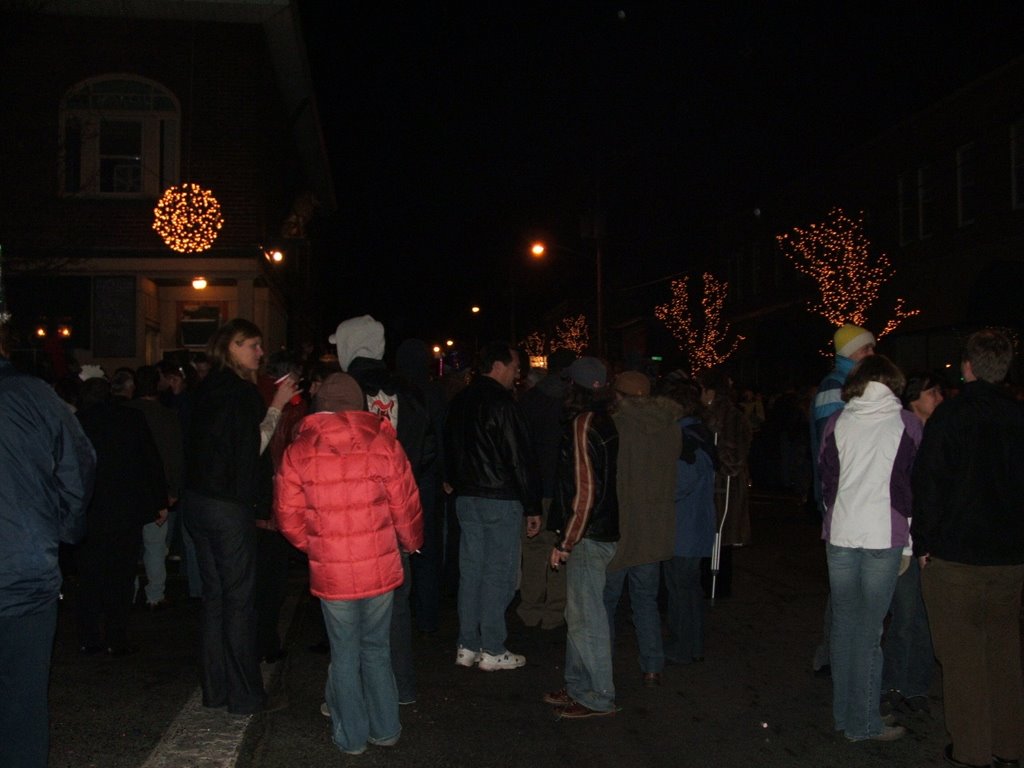 we figure it's officially the New Year when it hovers over the door of the Brass Cat...
 and there's a sprinkling of freezing rain and I'm ready to go inside myself.
 Happy New Year everyone! (hope the weather's better whereever you are...)
Also:
Beth Kanter is raising $50,000 for children in Cambodia
and
Lisa Williams launches Placeblogger
citizen journalism, media, Blogging, Blog, 2007
happy new year new year
Wednesday, December 27, 2006
Iraq War's Grimmest Statistics Have Yet to be Reported
The latest body count out of Iraq is somewhere around 2,974 souls. But that was as of a particular time yesterday. The toll is, by now, higher than 9/11. But there's more to "loss of life" than just physical death...esp.when compared with the walking death of OEF/OIF combat-reated Post-Traumatic Stress Disorder
Since 2005, my friend Ilona Meagher has done some amazing work documenting the the effects of OEF/OIF combat-related PTSD among returning GIs--the alcoholism, violence, chronic unemployment, and emotional devastation of families. A stunning work of citizen journalism, the PTSD Timeline hosted at ePluribus Media has become the most important reference/source of information on what's happening--right now--to our sons, daughters, husbands, wives, brothers, sisters, lovers.
(Yes, it's happening to women, too. Let us not forget that.)
 A book from her work Moving a Nation to Care: Post-Traumatic Stress Disorder and America’s Returning Troops. has finally hit the "review copy" status, and is on time for its May '07 release.
It can't come soon enough.
Bodybags are one thing--may they rest in peace. Walking dead are a totally different matter. They don't rest--ever. Nobody deserves that fate.
You can still follow the timeline and follow more stories at Ilona's blog PTSD Combat: Winning the War Within
citizen journalism, media, Blogging, Blog, Blogs, Iraq PTSD veterans posttraumatic stress disorder
Since 2005, my friend Ilona Meagher has done some amazing work documenting the the effects of OEF/OIF combat-related PTSD among returning GIs--the alcoholism, violence, chronic unemployment, and emotional devastation of families. A stunning work of citizen journalism, the PTSD Timeline hosted at ePluribus Media has become the most important reference/source of information on what's happening--right now--to our sons, daughters, husbands, wives, brothers, sisters, lovers.
(Yes, it's happening to women, too. Let us not forget that.)
 A book from her work Moving a Nation to Care: Post-Traumatic Stress Disorder and America’s Returning Troops. has finally hit the "review copy" status, and is on time for its May '07 release.
It can't come soon enough.
Bodybags are one thing--may they rest in peace. Walking dead are a totally different matter. They don't rest--ever. Nobody deserves that fate.
You can still follow the timeline and follow more stories at Ilona's blog PTSD Combat: Winning the War Within
citizen journalism, media, Blogging, Blog, Blogs, Iraq PTSD veterans posttraumatic stress disorder
Monday, December 25, 2006
Merry Christmas everyone!

the gifts have been opened...the hot chocolate is brewing...
don't think today(I'm not)...just enjoy.
but if you have to think:
check out Jill's collection of Christmas thoughts
and David Armando's Holiday Manifesto that I read while catching up with
Hugh MacLeod(who is slowly becoming my favorite blogger...on any day)

the gifts have been opened...the hot chocolate is brewing...
don't think today(I'm not)...just enjoy.
but if you have to think:
check out Jill's collection of Christmas thoughts
and David Armando's Holiday Manifesto that I read while catching up with
Hugh MacLeod(who is slowly becoming my favorite blogger...on any day)
Thursday, December 21, 2006
Blogging WOMMA: The Summit
The best thing about the WOMMA Summit was the number of amazingly talented, hard working, insightful, gracious individuals there. That goes for the general rabble as well as the speakers. No excess of A-list bloggers (who, apparently, were all in France at Le Web 3). No bloviating. No hyper-schmmozing to get in good graces or on blogrolls. The speakers were there to share their experiences. The audience was there to get info to help their businesses and clients understand the dizzying milieu of social media. And we were all there to learn something from one another.
More to come...
WOMMA WOMMA06
More to come...
WOMMA WOMMA06
Net Neutrality Battle Continues
Another great vid on Net Neutrality from Steve at COANews
The issue isn't settled--we have a new Congress. Vigilance is still a high priority.
The issue isn't settled--we have a new Congress. Vigilance is still a high priority.
Tuesday, December 19, 2006
Umbria Connect Sells Blogger URLs
First came teaser about Umbria Connect from MediaPost....which raised my eyebrows a bit:
Then I found this press release on Umbria Connect from PRWeb via Political FunnyBone (but not before getting some nasty evil splog I won't link to)....More U.C. details:
But what about informing people that their urls are being sold out for marketing purposes?
What sticks out to me as very weird and kind of against the way things go out here is Umbria then sells the blog URLs in blocks of 25 on a subscription basis--with either monthly or quarterly updates.
Okay...it's bad enough that our mailing addys are sent to whomever will pay for them. And it's so bad for our teleophone numbers that we had to start a National Do Not Call list.
But *selling* our URLs??
Okay, maybe it's only going to be the URLs of "influential" bloggers, and the rest of us schmoes are out in the cold...
but still...Umbria is selling our urls! not their service! Which means we may be dealing with more spam than we already get.
IMHO, this is NOT how social media works and could ultimately black-eye a company that misuses Umbria's info. It could also open the door to other kinds of rip-off,splog-related efforts.
But, even more, I didn't think our urls were the same as our telephone numbers or our mailing addresses.
Now, I may feel a bit for companies that don't want to invest in an in-house person for finding blogs, but this just doesn't feel any more right than Pay Per Post.
All I know is lots of folks just might end up feeling a lot spammier in the near future...
Just a thought.
Update: Shel Holtz offers his insightful $.02on the matter.
Blogging, Blog, Blogs, marketing
Umbria Connect gathers input from publicly available CGM sources to locate individual bloggers writing about topics or themes of interest to marketers. Umbria then sells the blog URLs in blocks of 25 on a subscription basis--with either monthly or quarterly updates.
Then I found this press release on Umbria Connect from PRWeb via Political FunnyBone (but not before getting some nasty evil splog I won't link to)....More U.C. details:
"Umbria Connect is a natural extension of our blogosphere segmentation capabilities," said Janet Eden-Harris, CEO, Umbria Inc. "This new offering enables us to support our clients close the loop on the blogosphere research and put the analysis to work in their individual outreach campaigns."
But what about informing people that their urls are being sold out for marketing purposes?
What sticks out to me as very weird and kind of against the way things go out here is Umbria then sells the blog URLs in blocks of 25 on a subscription basis--with either monthly or quarterly updates.
Okay...it's bad enough that our mailing addys are sent to whomever will pay for them. And it's so bad for our teleophone numbers that we had to start a National Do Not Call list.
But *selling* our URLs??
Okay, maybe it's only going to be the URLs of "influential" bloggers, and the rest of us schmoes are out in the cold...
but still...Umbria is selling our urls! not their service! Which means we may be dealing with more spam than we already get.
IMHO, this is NOT how social media works and could ultimately black-eye a company that misuses Umbria's info. It could also open the door to other kinds of rip-off,splog-related efforts.
But, even more, I didn't think our urls were the same as our telephone numbers or our mailing addresses.
Now, I may feel a bit for companies that don't want to invest in an in-house person for finding blogs, but this just doesn't feel any more right than Pay Per Post.
All I know is lots of folks just might end up feeling a lot spammier in the near future...
Just a thought.
Update: Shel Holtz offers his insightful $.02on the matter.
Blogging, Blog, Blogs, marketing
Blogging WOMMA: Ten Takeaways from the WOMMA Research Symposium
1. Nobody said tracking social media was going to be easy.
2. There are lots of different kinds of social media--from User Generated Content (UGC) to blogs to social networking communities to influencer-targeted parties--and a company might choose to use one, two or all different forms of social media to generate WOM.
3. Develop a social media strategy before jumping in. But don't base that strategy on a metric--base it on how much time your company can put in to human filtering.
4. Algorithms aren't the be-all-and-end-all for helping a company understand the landscape of social media.
5. Human filtrering is far more important than the right algorithim for locating and targeting the right influencers.
6. Whether it's face-to-face or online, humans are the key to generating WOM.
7. Online WOM works best for companies that know their customer's media habits. The more engaged a customer is with all kinds of electronic media, the more likely they will be to engage online social media endeavors.
8. Media-savvy customers will know when a company's behaving in a "too slick" manner and will have an unfavorable response to that particularly "slick" social media endeavor.
9. Even if you engage in all sorts of social media, it's not going to help if you refuse to respond to criticism or have a bad product.
10. Social media won't make a bad product better (but it just might get it off the market.)
WOMMA WOMMA06
2. There are lots of different kinds of social media--from User Generated Content (UGC) to blogs to social networking communities to influencer-targeted parties--and a company might choose to use one, two or all different forms of social media to generate WOM.
3. Develop a social media strategy before jumping in. But don't base that strategy on a metric--base it on how much time your company can put in to human filtering.
4. Algorithms aren't the be-all-and-end-all for helping a company understand the landscape of social media.
5. Human filtrering is far more important than the right algorithim for locating and targeting the right influencers.
6. Whether it's face-to-face or online, humans are the key to generating WOM.
7. Online WOM works best for companies that know their customer's media habits. The more engaged a customer is with all kinds of electronic media, the more likely they will be to engage online social media endeavors.
8. Media-savvy customers will know when a company's behaving in a "too slick" manner and will have an unfavorable response to that particularly "slick" social media endeavor.
9. Even if you engage in all sorts of social media, it's not going to help if you refuse to respond to criticism or have a bad product.
10. Social media won't make a bad product better (but it just might get it off the market.)
WOMMA WOMMA06
Monday, December 18, 2006
Blogging WOMMA: The Research Symposium
Some of the top researchers on Word of Mouth Marketing presented their work last Monday (12/12/06) at the Word Of Mouth Marketing Association’s Research Symposium. It was a curious place for me to be...just the old blogger/influencer/citizen/online journalist fly on the wall..
A quick overview: a number of case studies presented on a variety of metric-centered topics including how some retailers allow customers a "marketing voice" (which then helps determine ROI), the importance of consumer-generated media in various ad campaigns, the effect of splogs on metrics (this should be of great interest to the vast majority of us who blog. splogs hurt everybody).
At this point in time, there are different ways to calculate the influence of WOM for various kinds of products and marketing campaigns. Of highest priority was how the members of WOMMA might be able to agree on one standard metric for measuring the ROI of WOM.
That’s also the biggest conundrum. Matt McGlinn of BzzAgent, whose study “Measuring the Value of a Manage WOM program in Test & Control markets” won an award for Best Demonstration of ROI, stressed an understanding of the word of mouth phenomenon beyond universal metrics.
Essentialy, ROI can be great, but we’re really selling WOM short if the only reason to do it is contingent on ROI.
I was not disappointed by any of the sessions I attended at the Research Symposium, More than any other group of professionals, these folks seemed to really get that any sort of word of mouth marketing campaign can’t rely solely on hard sciences and algorithms, and must be a combination of technology and human flitering of information.
There is no way that marketers, if they want to engage in successful WOM, can avoid dealing with the human factors that can’t be traced in metrics.
One curious statistic though that was presented by the Keller Fay group (I think) was that 70% of WOM takes place face to face and only 4% of WOM happens online. It was also very rightly pointed out that those numbers can change contingent on the type of product that is being monitored. For instance, online WOM for a new video game might be higher than WOM for a new bleach.
That’s the kind of thing that seems very evident to me, but I’m sure isn’t evident to those who don’t spend the majority of their day swinging through the sinewy jungles of the blogosphere.
And since that's often the case when it comes to trying to convince businesses to do just a tiny bit of WOM.....
See more recaps of presentations at the fantastic WOMMA Research Blog
NOTE: WOMMA's really great about giving out Smart Schwag--case studies, books, notes, cds of sessions--that I will, from time to time, have updates on the info I got from them. It's just way too much for one blog post--but way too much in a good way!
citizen journalism, media,WOMMA
A quick overview: a number of case studies presented on a variety of metric-centered topics including how some retailers allow customers a "marketing voice" (which then helps determine ROI), the importance of consumer-generated media in various ad campaigns, the effect of splogs on metrics (this should be of great interest to the vast majority of us who blog. splogs hurt everybody).
At this point in time, there are different ways to calculate the influence of WOM for various kinds of products and marketing campaigns. Of highest priority was how the members of WOMMA might be able to agree on one standard metric for measuring the ROI of WOM.
That’s also the biggest conundrum. Matt McGlinn of BzzAgent, whose study “Measuring the Value of a Manage WOM program in Test & Control markets” won an award for Best Demonstration of ROI, stressed an understanding of the word of mouth phenomenon beyond universal metrics.
Essentialy, ROI can be great, but we’re really selling WOM short if the only reason to do it is contingent on ROI.
I was not disappointed by any of the sessions I attended at the Research Symposium, More than any other group of professionals, these folks seemed to really get that any sort of word of mouth marketing campaign can’t rely solely on hard sciences and algorithms, and must be a combination of technology and human flitering of information.
There is no way that marketers, if they want to engage in successful WOM, can avoid dealing with the human factors that can’t be traced in metrics.
One curious statistic though that was presented by the Keller Fay group (I think) was that 70% of WOM takes place face to face and only 4% of WOM happens online. It was also very rightly pointed out that those numbers can change contingent on the type of product that is being monitored. For instance, online WOM for a new video game might be higher than WOM for a new bleach.
That’s the kind of thing that seems very evident to me, but I’m sure isn’t evident to those who don’t spend the majority of their day swinging through the sinewy jungles of the blogosphere.
And since that's often the case when it comes to trying to convince businesses to do just a tiny bit of WOM.....
See more recaps of presentations at the fantastic WOMMA Research Blog
NOTE: WOMMA's really great about giving out Smart Schwag--case studies, books, notes, cds of sessions--that I will, from time to time, have updates on the info I got from them. It's just way too much for one blog post--but way too much in a good way!
citizen journalism, media,WOMMA
Tagged on a Meme: 5 things you don't know about me
Just did a quick search on Technorati and found I've been tagged by marketing diva (and maven) Toby Bloomberg on a very fun meme--which will probably raise a few eyebrows and make you think (but won't make your hair stand on end)...
so here goes:
5 Things you don't know about me(even if you've read my personal blog)
1. My "late night reading" consists mostly of Dashiell Hammett stuff and other noir novels. Figuring out mid 20th century euphemisms is fun!
2. I've been into one form of social media or another since about '92. It started with friends (who worked at H.P.) who were into techno and found out raves(see this history of hyperreal.) As a college student ('98-'01) I was an integral part of the New York Times Film Forum, posting under the moniker of ariadnae. It was a wonderful and interesting time--those guys and gals were great company and I learned a lot about how communities self-police, good board monitoring, and the like. I remember when LiveJournal launched as some college acquaintances were on it--some still are--but wasn't into that particular community. From the forums (there were others, too) I went into online dating. Won't bore with the details, but I picked up some very valuable skills for ferriting out fradulent profiles (and you'd be surprised *where* people place "alter ego" profiles...) Started blogging in November of '04 with a blog titled Love and Hope and Sex and Dreams--but don't like to post the url here, as some professional folk have a bit of "trouble" with reading anything personal about a potential colleague...which is why this blog was started. Both blogs have unique communities with a little overlap. But, essentially, guys like this one, women like the other--but a fair number of guys read the other too.
3. I crochet. Seriously. I've made doilies, afghans, dolls, baby blankies, and kitchen stuff. My Victorian bride doll won second prize at a county fair.
4. I recently moved to Easthampton, MA, where I live over an art gallery, which sits between a bakery (chocolate cakes to *die* for) and an ice cream parlor (where you can buy some of the best coffee on earth). There are also some amazing good eats, reasonably priced, in town (Amy's Place up the street from me, Ralphine's Deli, Nini's, and Blue Moon Grocery to name a few.) I've always wanted to live "in town"--Greenwich Village actually--and this is pretty close. We're also wifi'd like crazy out here. The only place that could possibly make me happier is the Village. but it's way too expensive. I can't imagine what my apt. would cost in NYC.
5. I've travelled cross country twice in my life and really want to do it again. Soon. I love the West. It's not the East. I also want to go back to Hawaii--where I was the happiest in my entire life.
Okay...so that's it. I know I should probably tag a few people, but give me a bit to figure out whom. I'll post that on an update at the top of this post...
so here goes:
5 Things you don't know about me(even if you've read my personal blog)
1. My "late night reading" consists mostly of Dashiell Hammett stuff and other noir novels. Figuring out mid 20th century euphemisms is fun!
2. I've been into one form of social media or another since about '92. It started with friends (who worked at H.P.) who were into techno and found out raves(see this history of hyperreal.) As a college student ('98-'01) I was an integral part of the New York Times Film Forum, posting under the moniker of ariadnae. It was a wonderful and interesting time--those guys and gals were great company and I learned a lot about how communities self-police, good board monitoring, and the like. I remember when LiveJournal launched as some college acquaintances were on it--some still are--but wasn't into that particular community. From the forums (there were others, too) I went into online dating. Won't bore with the details, but I picked up some very valuable skills for ferriting out fradulent profiles (and you'd be surprised *where* people place "alter ego" profiles...) Started blogging in November of '04 with a blog titled Love and Hope and Sex and Dreams--but don't like to post the url here, as some professional folk have a bit of "trouble" with reading anything personal about a potential colleague...which is why this blog was started. Both blogs have unique communities with a little overlap. But, essentially, guys like this one, women like the other--but a fair number of guys read the other too.
3. I crochet. Seriously. I've made doilies, afghans, dolls, baby blankies, and kitchen stuff. My Victorian bride doll won second prize at a county fair.
4. I recently moved to Easthampton, MA, where I live over an art gallery, which sits between a bakery (chocolate cakes to *die* for) and an ice cream parlor (where you can buy some of the best coffee on earth). There are also some amazing good eats, reasonably priced, in town (Amy's Place up the street from me, Ralphine's Deli, Nini's, and Blue Moon Grocery to name a few.) I've always wanted to live "in town"--Greenwich Village actually--and this is pretty close. We're also wifi'd like crazy out here. The only place that could possibly make me happier is the Village. but it's way too expensive. I can't imagine what my apt. would cost in NYC.
5. I've travelled cross country twice in my life and really want to do it again. Soon. I love the West. It's not the East. I also want to go back to Hawaii--where I was the happiest in my entire life.
Okay...so that's it. I know I should probably tag a few people, but give me a bit to figure out whom. I'll post that on an update at the top of this post...
Friday, December 15, 2006
Citizen journalism site Fresno Famous purchased by McClatchy Newspapers
Huge news in the world of citizen journalism: Fresno Famous, Cali citizen journalism site founded by Jara Euston was purchased by the Fresno Bee--one of the crown jewels in the historic McClatchy newspaper chain...
While the Bee will own Fresno Famous, it will be managed separately from the newspaper:
Congratulations Jara!
Sister site Modesto Famous was also purchased by McClatchy.
Bender will be taking over management of Fresno Famous from Euston, who will aid with the transition over the next six months.
This development, in a unusual way, echoes the evolution of the McClatchy chain. In the last century--1922 to be exact--Carlos McClatchy launched the Fresno Bee. In 1927, McClatchy bought the News-Herald of Modesto and renamed it the Modesto Bee.
And let's all hope that McClatchy keeps its word on maintaining the integrityity of both Fresno Famous and its sister Modesto Famous...but read the comments in the Fresno Famous post about the takeover. IMHO, I worry about this sort of thing because there is a need for independent, watchdog citizen journalism sites. It's not to say that all local papers are horrid and corrupt, with crappy, meaningless journalism--no, not at all. But sometimes stories fall through the cracks at local papers (that, nowadays, are squeaking for cash) and having a web presence that looks at a different side of the local scene isn't really a bad thing. Many in the mainstream journalism community don't seem to trust The People to write about where they live with a level of journalistic integrity--a good portion of the journalism community have bought the hype that because they have a particular education that they are of a "priestly" class (I've heard it--it's nauseating.) That kind of talk reminds me of the elitism among Christiantan preachers--there are those who go to high-brow Divinity schools, and those who preach without a "fancy education." Yet both are preachers and both serve the people in their own ways. Both types of preachers do their part to preserve freedom of religion in this country...doesn't it seem to follow, then, that two kinds of journalism, the kind practiced in newsrooms and the kind practiced on cit j sites, are both doing their thing to preserve freedom of speech?
think about it.
Journalism, citizen journalism, media, Blogging, Blog, Blogs, McClatchy Fresno
While the Bee will own Fresno Famous, it will be managed separately from the newspaper:
"Fresno Famous will remain separate from The Fresno Bee newspaper, but will gain the resources of a much larger media company. We owe our success to the community of users on the site, and know this sale will only improve user experience," said Euston.
Congratulations Jara!
Sister site Modesto Famous was also purchased by McClatchy.
"Purchasing a strong franchise such as FresnoFamous.com gives The Bee another way in which to reach younger readers with information they seek," said Valerie Bender, vice president of custom publications for The Bee. “Our intention is to keep the high standard of blogging and information that has led to the success of FresnoFamous.com and to, over time, continue to grow the content and opportunities for citizen journalism on the site."
Bender will be taking over management of Fresno Famous from Euston, who will aid with the transition over the next six months.
This development, in a unusual way, echoes the evolution of the McClatchy chain. In the last century--1922 to be exact--Carlos McClatchy launched the Fresno Bee. In 1927, McClatchy bought the News-Herald of Modesto and renamed it the Modesto Bee.
And let's all hope that McClatchy keeps its word on maintaining the integrityity of both Fresno Famous and its sister Modesto Famous...but read the comments in the Fresno Famous post about the takeover. IMHO, I worry about this sort of thing because there is a need for independent, watchdog citizen journalism sites. It's not to say that all local papers are horrid and corrupt, with crappy, meaningless journalism--no, not at all. But sometimes stories fall through the cracks at local papers (that, nowadays, are squeaking for cash) and having a web presence that looks at a different side of the local scene isn't really a bad thing. Many in the mainstream journalism community don't seem to trust The People to write about where they live with a level of journalistic integrity--a good portion of the journalism community have bought the hype that because they have a particular education that they are of a "priestly" class (I've heard it--it's nauseating.) That kind of talk reminds me of the elitism among Christiantan preachers--there are those who go to high-brow Divinity schools, and those who preach without a "fancy education." Yet both are preachers and both serve the people in their own ways. Both types of preachers do their part to preserve freedom of religion in this country...doesn't it seem to follow, then, that two kinds of journalism, the kind practiced in newsrooms and the kind practiced on cit j sites, are both doing their thing to preserve freedom of speech?
think about it.
Journalism, citizen journalism, media, Blogging, Blog, Blogs, McClatchy Fresno
Thursday, December 14, 2006
Sony PS3 Flog: it ain't portable nut!
Well, Sony's been busted for creating a "flog" as part of their PS3 advertising campaign. Aside from the un-hipster version of hip-hopspeak that pervaded the thing, there was a problem with the splogger-style "glued" word url (alliwantforxmasisapsp.com), as well as the artwork on the flog (here's the headder): 
Take a good look at the title--doesn't the artwork kind of resemble these little guys:
from last December's urban squirrels commercials (which lots of people liked--well, after they dealt with the graffitti-as-advertising scandal...)
Big commpanies have to get a lot wiser about their ad campaigns. Or is it that agencies like Zipatoni need to get a grip and hire people who know the social media space. Don't try to run with the Natives if your feet can't take the heat...
(thanks gregverdino2.0 for the headder)
UpdateOnline Media Daily reports Zipitoni's mea culpa for the PSP flog. Yet the fault also lies with Sony--a company that tries too hard to be "street."
Take a good look at the title--doesn't the artwork kind of resemble these little guys:

from last December's urban squirrels commercials (which lots of people liked--well, after they dealt with the graffitti-as-advertising scandal...)
Big commpanies have to get a lot wiser about their ad campaigns. Or is it that agencies like Zipatoni need to get a grip and hire people who know the social media space. Don't try to run with the Natives if your feet can't take the heat...
(thanks gregverdino2.0 for the headder)
UpdateOnline Media Daily reports Zipitoni's mea culpa for the PSP flog. Yet the fault also lies with Sony--a company that tries too hard to be "street."
Wednesday, December 13, 2006
Blogging WOMMA: the Last Day

Wednesday, Dec 13. 5:08pm I'm exhausted. Three days of information--some of that number-related--and networking. I think I still have a voice, but I'm not sure. I know my brain's in the process of a nuclear-style meltdown from all the stimulus and I can't wait to sleep on the plane....which isn't until 9:15pm.
I'd planned to liveblog some of the sessions of the con, but the free wifi was awful and I didn't want to pony up the 20 bucks a day for the good one (that is, if I *could* pick up the good one--there was no guarantee.)
I've come to expect crappy wifi at most cons I'm at--even strictly tech and blogging cons--because most places just don't boost the signal enough.
Such is high tech life in a medium-tech world...
and my suitcase is twice as heavy as it was before I left. Must be all the books. That's the great thing about marketing cons--all the "smart" schwag.
Will blog much more about the con tomorrow...
oh, spoke to a Georgetown student last night about online communities and newspapers. Will have more on that too...
off to dinner. ...
Sunday, December 10, 2006
Blogging WOMMA: Sunday Night
Washington D.C.: In town to blog the Word of Mouth Marketing Assoc Research Symposium (12/11) and Marketing Summit (12/12-13)
There's a lot going on here--some case studies and metrics analysis. This will be one of the few conferences I've attended that's been strictly on business (the other, high-level strictly business con was Corante's Innovative Marketing Conference. I met some amazing people there, and learned a lot.)
Folks from Forrester, Nielsen BuzzMetrics, Cymfony and the like will be presenting. A little more "hard" discussion on the business end of blogging and social networking...
Tonight though it's been mostly settling in, calling a friend, discovering I forgot something important (and trying to find a way to replace it), going out a bit...
Went for a walk at dusk. Got a hot pretzel and made my way over to the World War II Memorial
Memorials (and the Capitol for that matter) take on a whole different aura at night. (sorry for the canned photo--cell phone was charging and left the digi at home)
No fear of walking after dark--being middle aged and geeky renders one relatively invisible in a wealthy country where appearances count for much. On some level, though, it's very liberating to be invisible.
Had a mediocre fish dinner at an expensive restaurant (last time I take myself out for an expensive meal ;-) ) Overly flirty waiter (did I look that desperate?) and very good wine.
Time for bed though. Registration is at 6:30, which means I get up by 5:00 at least. I like to get to these things before the crowd.
more to come...
There's a lot going on here--some case studies and metrics analysis. This will be one of the few conferences I've attended that's been strictly on business (the other, high-level strictly business con was Corante's Innovative Marketing Conference. I met some amazing people there, and learned a lot.)
Folks from Forrester, Nielsen BuzzMetrics, Cymfony and the like will be presenting. A little more "hard" discussion on the business end of blogging and social networking...
Tonight though it's been mostly settling in, calling a friend, discovering I forgot something important (and trying to find a way to replace it), going out a bit...
Went for a walk at dusk. Got a hot pretzel and made my way over to the World War II Memorial

Memorials (and the Capitol for that matter) take on a whole different aura at night. (sorry for the canned photo--cell phone was charging and left the digi at home)
No fear of walking after dark--being middle aged and geeky renders one relatively invisible in a wealthy country where appearances count for much. On some level, though, it's very liberating to be invisible.
Had a mediocre fish dinner at an expensive restaurant (last time I take myself out for an expensive meal ;-) ) Overly flirty waiter (did I look that desperate?) and very good wine.
Time for bed though. Registration is at 6:30, which means I get up by 5:00 at least. I like to get to these things before the crowd.
more to come...
Sunday, December 03, 2006
When Sara Lee met Ren & Stimpy, My Holidays Would Never Be The Same
Well, advertising smarties have once again done something to leave an indelible impression on my delicate psyche: I've seen the new holiday commercial for Sara Lee pound/cheese and other cakes that uses the ole "Happy, Happy, Joy, Joy" song from Ren and Stimpy (complete with holidy jingle bells.) I can't seem to find the holiday commercial, but it wasn't the first Sara Lee commercial to use the song. Sara Lee launched what's called its "Joy of Eating" campaign with a bread commercial that shows a number of people who are of the age to remember exactly where the "Happy, Happy, Joy, Joy" song comes from:
What's probably funnier is what the Chicago Sun Times had to say about the campaign, which is reported as named "The Joy of Eating"--in order to remind people of The Joy of Sex. However, whomever wrote the article seems to be woefully ignorant of the source material of the music, calling it "a mildly annoying jingle that speeds up along with the procession of images."
Okay...so, the Chicago Sun Times seems to forget that most people never hear of, nor learn, the names of ad campaigns--But by golly gosh we certainly do hear, and sometimes even know, the source material for their jingles! (mostly, too, because they don't hire jingle-writers these days. It's cheaper to rewriter--or just use outright--old stuff.)
It's too creepy to think that the ad agency, TWBA/Chiat/Day might have been thinking sex and ended up channeling Ren and Stimpy. All I can think is what the heck is going on in *that* creative department!
Just makes me think they've got to be a bunch of sick little monkeys...
AdWeek's AdFreak Blog even fails to mention the Ren & Stimpy connection, but the few commenters definitley remember...as did a fair number of astute bloggers including one who even posts the lyrics--which are anything but appetite (food OR sex) inducing. Watch it here and tell me if it makes y'all think of anything a grown-up as sex or politely eating a sandwich:
But I think it's intentional: I don't think, as the Sun Times reporter writes, that we're supposed to make the Joy of Eating/Joy of Sex connection. I think we're supposed to make the "food is fun! all the kids are doing it!" connection. Heck, just look at the faces of the folks in the bread commercial...they're hardly expressing sensual ecstacy as much as they are a child-like delight in gluttony--as in stuffing one's face like an eeediot and not worrying about the calories.
It's about letting go and being a kid--not about sex. If they wanted to equate food and sex (rather than food as kid fun) they would certainly found another song.
So, just goes to show how out of touch the Establishemen is if they can't even get the why a company might want to use a song from Ren & Stimpy to sell bread and cake to grownups. It's got nothing to do with sex and everything to do with being a kid again.
What's probably funnier is what the Chicago Sun Times had to say about the campaign, which is reported as named "The Joy of Eating"--in order to remind people of The Joy of Sex. However, whomever wrote the article seems to be woefully ignorant of the source material of the music, calling it "a mildly annoying jingle that speeds up along with the procession of images."
Okay...so, the Chicago Sun Times seems to forget that most people never hear of, nor learn, the names of ad campaigns--But by golly gosh we certainly do hear, and sometimes even know, the source material for their jingles! (mostly, too, because they don't hire jingle-writers these days. It's cheaper to rewriter--or just use outright--old stuff.)
It's too creepy to think that the ad agency, TWBA/Chiat/Day might have been thinking sex and ended up channeling Ren and Stimpy. All I can think is what the heck is going on in *that* creative department!
Just makes me think they've got to be a bunch of sick little monkeys...
AdWeek's AdFreak Blog even fails to mention the Ren & Stimpy connection, but the few commenters definitley remember...as did a fair number of astute bloggers including one who even posts the lyrics--which are anything but appetite (food OR sex) inducing. Watch it here and tell me if it makes y'all think of anything a grown-up as sex or politely eating a sandwich:
But I think it's intentional: I don't think, as the Sun Times reporter writes, that we're supposed to make the Joy of Eating/Joy of Sex connection. I think we're supposed to make the "food is fun! all the kids are doing it!" connection. Heck, just look at the faces of the folks in the bread commercial...they're hardly expressing sensual ecstacy as much as they are a child-like delight in gluttony--as in stuffing one's face like an eeediot and not worrying about the calories.
It's about letting go and being a kid--not about sex. If they wanted to equate food and sex (rather than food as kid fun) they would certainly found another song.
So, just goes to show how out of touch the Establishemen is if they can't even get the why a company might want to use a song from Ren & Stimpy to sell bread and cake to grownups. It's got nothing to do with sex and everything to do with being a kid again.
Thursday, November 30, 2006
Is it ever okay to print trollspeak in a newspaper?
Over at Poynter's E-Media Tidbits, Amy's got a post that asks whether or not it's ever okay to print ad hominem attacks from a newspapers website...
This may seem like a no-brainer to those of us who've spent some time running around blogs and forums and message boards: the simple rule of thumb is that if the attack is anonymous, from a source totally and wholly unknown to the community, and there's absolutely no way to verify the i.d. of the person who made the comment, then it's a troll and just move along, don't give it any traction whatsoever.
Even if it's an anonymous poster who's know to the community, whether or not to print the comment should be contingent on the credibility and transparency of the author (Mark Glaser at Mediashift has an excellent post on the bloggers' view of transparency and credibility-even though most of the bloggers are high-level exec types ;-), still a very good read.)
In other words, if the person leaving the ad hominem comment is known to the group, maybe even known for that kind of thing, then that doesn't mean it should be printed. A credible ranter could be fun to the general community, but is that rant newsworthy? Further, continual ranting doesn't necessary equate with transparency either--perhaps in identifying the person in a certain way, but that's more a sense of being two-dimensional rather than transparent. Think of it this way: do quotes from Spider Man comics merit reprint on the editorial page? (I know, some of you might say *yes* but I'm talking in the formal news sense here...)
And what about verifying and asking the person to print the rant? Amy's piece doesn't give any indication as to whether or not the paper in question just plucked the stuff from the web or if they asked that it be used. If the paper did indeed ask, then it becomes a matter of why the paper would want to print this sort of thing in the first place.
Which leads me to wonder about how some newspapers view the stuff that comes into their web publications. Do they have someone monitoring their forums, blogs, etc. who might know the community? Do they have a policy regarding reprints of web based comments?--which they should. If there's a policy in place regarding letters to the editor, and if there is a policy, written or informal, about reprinting local gossip, then there should be some policy or understanding about reprinting screeds/rants/ and other web-based comments/bashes.
In my comment over at Poynter, I alluded to the perhaps-maybe possibility that this particular California newsroom in question is a bit confused about the concept of giving the people a voice. Giving people a voice, in most instances, means printing stuff that people are willing to sign their names to (unless it's super-hot and could hurt them in some way) and that will perhaps stimulate thought and conversation. Maybe the National enquirer and the Star make big bucks off printing stuff that is more whisper-down-the-lane than it is news, but what about when a local daily does this? Do they really think that the people in their area really want to read what amounts to a rotten tomato-throw from the rabble? And does someone in that newsroom perhaps think that the web is only about rabble-thrown rotten tomatoes?? Yes, I know that's being a bit rough on the average newsroom, but I've heard and read commentary to that effect from newspaper folk, which is troubling... (Michael Kinsley, who's been around a bit, seems to hold the opinion that anonymity is "supposed to be one of the signature qualities of the web"--guess he's been missing all the talk on credibility and transparency. )
Overall, there's no way to know exactly what every daily paper across the country thinks about commenters to its websites; but, the Califorina (Amy corrects: not California) reprints make me wonder how many other papers are either doing the same thing, or just, in general, not getting what's happening with communities on the web and think it's all about being anonymous and acting trollish. If that's the case, then I would begin to wonder what, exactly, they think of their web-based newspaper reading constiuency? Do they think the web readers are lesser than the print readers? And do they get that if they drop the ball on understanding some of the nuances of their web reading community, they may end up failing the entire community?
Journalism, citizen journalism, media, Blogging,
This may seem like a no-brainer to those of us who've spent some time running around blogs and forums and message boards: the simple rule of thumb is that if the attack is anonymous, from a source totally and wholly unknown to the community, and there's absolutely no way to verify the i.d. of the person who made the comment, then it's a troll and just move along, don't give it any traction whatsoever.
Even if it's an anonymous poster who's know to the community, whether or not to print the comment should be contingent on the credibility and transparency of the author (Mark Glaser at Mediashift has an excellent post on the bloggers' view of transparency and credibility-even though most of the bloggers are high-level exec types ;-), still a very good read.)
In other words, if the person leaving the ad hominem comment is known to the group, maybe even known for that kind of thing, then that doesn't mean it should be printed. A credible ranter could be fun to the general community, but is that rant newsworthy? Further, continual ranting doesn't necessary equate with transparency either--perhaps in identifying the person in a certain way, but that's more a sense of being two-dimensional rather than transparent. Think of it this way: do quotes from Spider Man comics merit reprint on the editorial page? (I know, some of you might say *yes* but I'm talking in the formal news sense here...)
And what about verifying and asking the person to print the rant? Amy's piece doesn't give any indication as to whether or not the paper in question just plucked the stuff from the web or if they asked that it be used. If the paper did indeed ask, then it becomes a matter of why the paper would want to print this sort of thing in the first place.
Which leads me to wonder about how some newspapers view the stuff that comes into their web publications. Do they have someone monitoring their forums, blogs, etc. who might know the community? Do they have a policy regarding reprints of web based comments?--which they should. If there's a policy in place regarding letters to the editor, and if there is a policy, written or informal, about reprinting local gossip, then there should be some policy or understanding about reprinting screeds/rants/ and other web-based comments/bashes.
In my comment over at Poynter, I alluded to the perhaps-maybe possibility that this particular California newsroom in question is a bit confused about the concept of giving the people a voice. Giving people a voice, in most instances, means printing stuff that people are willing to sign their names to (unless it's super-hot and could hurt them in some way) and that will perhaps stimulate thought and conversation. Maybe the National enquirer and the Star make big bucks off printing stuff that is more whisper-down-the-lane than it is news, but what about when a local daily does this? Do they really think that the people in their area really want to read what amounts to a rotten tomato-throw from the rabble? And does someone in that newsroom perhaps think that the web is only about rabble-thrown rotten tomatoes?? Yes, I know that's being a bit rough on the average newsroom, but I've heard and read commentary to that effect from newspaper folk, which is troubling... (Michael Kinsley, who's been around a bit, seems to hold the opinion that anonymity is "supposed to be one of the signature qualities of the web"--guess he's been missing all the talk on credibility and transparency. )
Overall, there's no way to know exactly what every daily paper across the country thinks about commenters to its websites; but, the Califorina (Amy corrects: not California) reprints make me wonder how many other papers are either doing the same thing, or just, in general, not getting what's happening with communities on the web and think it's all about being anonymous and acting trollish. If that's the case, then I would begin to wonder what, exactly, they think of their web-based newspaper reading constiuency? Do they think the web readers are lesser than the print readers? And do they get that if they drop the ball on understanding some of the nuances of their web reading community, they may end up failing the entire community?
Journalism, citizen journalism, media, Blogging,
Tuesday, November 21, 2006
Thursday, November 16, 2006
Monday, November 06, 2006
One more week away I will be away from blogging here for one more week while I co-ordinate voluteers for the Northampton Independent Film Festival where I am an Associate Director.
It's always a great time, but if you've ever co-ordinated a fairly good sized event that runs over a period of days, you'll know that it simply consumes your life for the time it is going on. I've already put together a party for 300 people on opening night--not to mention staffing 4 different locations for 12 hours over 4 days.
Luckily, this year I live only 10-15 minutes away.
I should resume posting here around November 12 or 13. There will be some catching-up to do, that's for sure!
It's always a great time, but if you've ever co-ordinated a fairly good sized event that runs over a period of days, you'll know that it simply consumes your life for the time it is going on. I've already put together a party for 300 people on opening night--not to mention staffing 4 different locations for 12 hours over 4 days.
Luckily, this year I live only 10-15 minutes away.
I should resume posting here around November 12 or 13. There will be some catching-up to do, that's for sure!
Wednesday, October 11, 2006
On Bloggers as Journalists and the Dilemma of Disclosure
The following was written in response to this post on RoughType concerning an incident at the recent Online Journalism Association conference and a matter of disclosure (for the best blow-by-blow of the OJA session, read Staci @ PaidContent)
Arrington excoriating Jarvis...isn't that kind of like Jimmy Olsen taking Perry White to task for allowing Clark and Lois to work together??
But seriously, I always have to wonder how, and why, Arrington's now on so many panels from journalism cons to Bloggercon to Office 2.0, and speaking with such authority on so much, when he's really just a lawyer who wrote up a good business plan for a blog and has a very nice and congenial writing style...(disclosure for this blog: yes, I read TechCrunch on occasion, and actually like it--and I've never met M.A. f2f)
Okay, now let me get serious: yes, this is definitely about disclosure, and the need to disclose--I also see conversation, and the personnas we bring to blogging vs. the personnas left out of print.
As a conversation medium, blogging doesn't necessarily demand that we disclose everything, even about business deals. Blogging can be like a fan-dance--it reveals as much as it conceals. That is, unless we plan to use our blogging as an entree into journalism--and desire to be as credible as the profession is assumed to be. If that is the case, then it is upon us as bloggers to gain credibility by following some of the basic ethical rules of journalism--disclose sources (something the Edelman Wal-mart bloggers didn't do) *and* disclose possible conflicts of interest.
In speaking about the imprisonment of videoblogger Josh Wolfe in Online Journalism Review, Christine Tatum, President of SPJ, said she supported him, but was troubled by his statments of being an "advocate" while wanting to claim free speech protection as a journalist. "I think that it's very important for online journalists to begin to understand.. that it's very, very important that you do maintain some sort of objectivity and distance" she said.
So, bloggers who decide to turn what they are doing into online journalism (slightly different than citizen journalism) walk a balance between the conventions of conversation (some, which are particular to the blogosphere) and conventions of the profession of journalism. As we do this, we also wrestle with personna. If we are too journalistic, will those who read us assume we can't converse directly with them? If we too "bloggy" will journalists think we're somehow less than?
Bloggers who aspire to online journalism can indeed learn a lot from journalists--but journalists can learn some things from bloggers too--like how we convey information *and* carry on conversation without getting bugged by it (and retaliating a'la Hiltzik and Siegle.) But I'm not sure Arrington's the right blogger to be quaterbacking all the time.
(btw, I wrote on journalists and conversation for OJR--now used as reading in some journo ethics classes. thought I'd disclose...)
And speaking of disclosure: a freelance journalist who works for the Washington Post was fired because he did not disclose the small fact that a pro-Wal-Mart special interest group was paying for the RV (and then some) he was using for the WaPo assignment. He was also blogging about it Why is it that folks who are pro-Wal-Mart often like to leave out of whatever they are into that this is their position? In this case, as a freelanger being paid by Big Media, he did indeed have a right to disclose. In my ethical world, if I'm being paid by someone to do a job, then the job comes before my blog, which, even if I had ads, wouldn't give me enough to live off of for any length of time. More importantly, I can't act like a double-agent and sleep with Jams Bond while sleeping with Goldfinger. (And you know what happened in that movie....the same thing happened to the freelancer. More or less.)
Journalism, citizen journalism,journalism ethics, media web 2.0 identity
Arrington excoriating Jarvis...isn't that kind of like Jimmy Olsen taking Perry White to task for allowing Clark and Lois to work together??
But seriously, I always have to wonder how, and why, Arrington's now on so many panels from journalism cons to Bloggercon to Office 2.0, and speaking with such authority on so much, when he's really just a lawyer who wrote up a good business plan for a blog and has a very nice and congenial writing style...(disclosure for this blog: yes, I read TechCrunch on occasion, and actually like it--and I've never met M.A. f2f)
Okay, now let me get serious: yes, this is definitely about disclosure, and the need to disclose--I also see conversation, and the personnas we bring to blogging vs. the personnas left out of print.
As a conversation medium, blogging doesn't necessarily demand that we disclose everything, even about business deals. Blogging can be like a fan-dance--it reveals as much as it conceals. That is, unless we plan to use our blogging as an entree into journalism--and desire to be as credible as the profession is assumed to be. If that is the case, then it is upon us as bloggers to gain credibility by following some of the basic ethical rules of journalism--disclose sources (something the Edelman Wal-mart bloggers didn't do) *and* disclose possible conflicts of interest.
In speaking about the imprisonment of videoblogger Josh Wolfe in Online Journalism Review, Christine Tatum, President of SPJ, said she supported him, but was troubled by his statments of being an "advocate" while wanting to claim free speech protection as a journalist. "I think that it's very important for online journalists to begin to understand.. that it's very, very important that you do maintain some sort of objectivity and distance" she said.
So, bloggers who decide to turn what they are doing into online journalism (slightly different than citizen journalism) walk a balance between the conventions of conversation (some, which are particular to the blogosphere) and conventions of the profession of journalism. As we do this, we also wrestle with personna. If we are too journalistic, will those who read us assume we can't converse directly with them? If we too "bloggy" will journalists think we're somehow less than?
Bloggers who aspire to online journalism can indeed learn a lot from journalists--but journalists can learn some things from bloggers too--like how we convey information *and* carry on conversation without getting bugged by it (and retaliating a'la Hiltzik and Siegle.) But I'm not sure Arrington's the right blogger to be quaterbacking all the time.
(btw, I wrote on journalists and conversation for OJR--now used as reading in some journo ethics classes. thought I'd disclose...)
And speaking of disclosure: a freelance journalist who works for the Washington Post was fired because he did not disclose the small fact that a pro-Wal-Mart special interest group was paying for the RV (and then some) he was using for the WaPo assignment. He was also blogging about it Why is it that folks who are pro-Wal-Mart often like to leave out of whatever they are into that this is their position? In this case, as a freelanger being paid by Big Media, he did indeed have a right to disclose. In my ethical world, if I'm being paid by someone to do a job, then the job comes before my blog, which, even if I had ads, wouldn't give me enough to live off of for any length of time. More importantly, I can't act like a double-agent and sleep with Jams Bond while sleeping with Goldfinger. (And you know what happened in that movie....the same thing happened to the freelancer. More or less.)
Journalism, citizen journalism,journalism ethics, media web 2.0 identity
Monday, October 09, 2006
Google buys YouTube to Tune of $1.65 billion
Google buys YouTube for $1.65 billion That's $0.05 billion more than originally thought the search giant would pay for the video upload giant
I wonder if Mark Cuban, who recently said something to the effect of "anyone who buys that (YouTube) is a moron" because of potential lawsuits and copywright violations is still thinking that on this fine autumn evening....
Journalism, citizen journalism, media youtube,google, tech
I wonder if Mark Cuban, who recently said something to the effect of "anyone who buys that (YouTube) is a moron" because of potential lawsuits and copywright violations is still thinking that on this fine autumn evening....
Journalism, citizen journalism, media youtube,google, tech
Where do you live, citizen journalist? Flattening the Hyperlocal Concept
In many corners of the journalism establishment, hyperlocal citizen journalism blogs or placeblogs are all the rage. Some newspapers want to emulate them, others want to stomp them into the ground. But if you think about it, in an Internet Age of long tails, niches, and an increasingly flat world, the term "hyperlocal" can itself end up...well...flat...
On My Heart's in Accra, Ethan Zuckerman posted some fabulous thoughts on the idea of "being there" and citizen journalism. Ethan notes that the current perception and emphasis is on what he refers to as "being there" citizen journalism: photos of the Asian tsunami and the London bombings. Yet there's more to just "being there":
He's got a very good point! Still, there's more to what Ethan's saying about broadening--or, perhaps flattening--the idea of "being there" citizen journalism. Some of GVO's editors, Ndesanjo Macha the Africa editor and Neha Viswanathan who covers India, do so from homes far removed from their homelands. Ethan forwards the idea that it is their expertise on these particular geographic regions that makes them qualified to edit on those regions for GVO.
Yes, they have expertise--and Ethan points that existing media outlets might be threatened by citizens with expertise. Totally agree on that one, too--even though I know that some journalists might argue that citizens with expertise make bad journalists because they *may* (in their view) lack objectivity.
However, let's take Ethan's thought one step further--into the realm of hyperlocal. Hyperlocal is a form of "being there" citizen journalism, no doubt, but in this quickly evolving online space, "being there" and "hyperlocal" can take on a meaning beyond geography. What if we find ourselves "citizens" of a particular place within the boundless boundaries of the Internet? Are we, perhaps, then "hyperlocal" citizen journalists when we are writing about the corners of the Internet that we patrol/troll regularly?
Perhaps so--but this way of thinking requires that we stretch our sense of what we mean by concepts such as "community." In social networking, "community" is sometimes defined as places such as MySpace, YouTube, or any other social networking software space we (1)keep a profile and (2)participate regularly. So, could someone not write about a particular corner of MySpace as if it is their neighborhood?
Think about it.
The concept could stretch our ideas of what, where, and how we get expertise. Can we indeed get expertise from being online, social networking, for a prolonged length of time? Absolutely! Could we know more than the individual who never participates online, in social media? Absolutely!
What are the psychological/social implications of all this--to us as individuals and as groups? Do we think of particular websites/forums/blogs/etc. or "spaces" in the same way we might think of our physical neighborhoods? Do some of us split ourselves in two--allow our unsupervised Ids to run wild in cyberspace while maintaining a buttoned-down Real Life (in that case, though, which life is truly the real one?)
Have some of us gone far enough to have developed professional as well as personal lives on the 'net? Absolutely. There are, probably, more of us than the physical world realizes...
As I participated in the NYTimes Film Forum (98-'01), my idea of what constituted a "friend" changed. I had many "friends" in that space that I would never meet IRL because of the geographic distance. As I now write for online publications, my sense of workplace has changed. I touch base with editors and such, but rarely do I sit with them over lunch, talk on the phone, or get direct feedback from them. I must be very self-disciplined and self-directed. In my life, then, there has been an evolution from online social space to online work place. The Real, or physical, world has played a role in the movement from online social to online work--a necessity because the totality of who we are does not, and cannot, be contained within the boundless boundaries of the Internet.
We are, after all, physical creatures, and on some level require face to face meeting.....we learn from all our senses, not just those we use online.
(contrary to a popular conceit, one not need to be an engineer-hardware or software--to have expertise in this space. to say that only engineers can have expertise of this space is like saying only architects or city planners can have expertise enough to write about what it is to live in a particular place. think about it. the internet is more than engineering. Some folks built it, and lots of us live in it.)
Yet my sense of the world, overall, is that it is "flat." My sense of neighborhood and of friends is one more of affinity and expertise than of geography. Therefore, I am committing an act of "hyperlocal" journalism (citizen or professional) when I am writing about the places/spaces/sensibilities on the Internet that I know just as well as I know the shortest route to the Chicopee Wal-Mart and my neighbor's first name. My "beat" as a journalist is media--it is the world online, just the way for someone else it might be Greenfield or Chicopee or Springfield.
I live here in this online space as much as I live in a physical space. It's the way many of us live today..It is our "hyperlocal"....
Think about it.
(thanx Dave Weinberger for Ethan link....)
Further Reading:
Doc's ten clues to help newspapers--let's all stop using the term "content" please!! it doesn't make y'all sound any smarter....
When hyperlocal goes wrong: The Knoxville News-Sentinel decided to give front-page coverage to a 15-year old's decadent birthday party, and the citizens gave them what-for. And they're right. This is not responsible hyperlocal coverage. If someone wanted to blog about it, that's one thing--but then it would be pretty crappy hyperlocal citizen journalism on a non-story. (thanx Bob Stepno--very cool! via Doc...)
Jay Rosen Interviewed on Slashdot-- citizen journalism, NewAssignment.net and a few other things...
Journalism, citizen journalism,journalism ethics, media hyperlocal web 2.0 identity
On My Heart's in Accra, Ethan Zuckerman posted some fabulous thoughts on the idea of "being there" and citizen journalism. Ethan notes that the current perception and emphasis is on what he refers to as "being there" citizen journalism: photos of the Asian tsunami and the London bombings. Yet there's more to just "being there":
But I think there's another place where citizen's media may be at least as important - introducing citizen expertise on subjects where existing journalists may not be expert
He's got a very good point! Still, there's more to what Ethan's saying about broadening--or, perhaps flattening--the idea of "being there" citizen journalism. Some of GVO's editors, Ndesanjo Macha the Africa editor and Neha Viswanathan who covers India, do so from homes far removed from their homelands. Ethan forwards the idea that it is their expertise on these particular geographic regions that makes them qualified to edit on those regions for GVO.
Yes, they have expertise--and Ethan points that existing media outlets might be threatened by citizens with expertise. Totally agree on that one, too--even though I know that some journalists might argue that citizens with expertise make bad journalists because they *may* (in their view) lack objectivity.
However, let's take Ethan's thought one step further--into the realm of hyperlocal. Hyperlocal is a form of "being there" citizen journalism, no doubt, but in this quickly evolving online space, "being there" and "hyperlocal" can take on a meaning beyond geography. What if we find ourselves "citizens" of a particular place within the boundless boundaries of the Internet? Are we, perhaps, then "hyperlocal" citizen journalists when we are writing about the corners of the Internet that we patrol/troll regularly?
Perhaps so--but this way of thinking requires that we stretch our sense of what we mean by concepts such as "community." In social networking, "community" is sometimes defined as places such as MySpace, YouTube, or any other social networking software space we (1)keep a profile and (2)participate regularly. So, could someone not write about a particular corner of MySpace as if it is their neighborhood?
Think about it.
The concept could stretch our ideas of what, where, and how we get expertise. Can we indeed get expertise from being online, social networking, for a prolonged length of time? Absolutely! Could we know more than the individual who never participates online, in social media? Absolutely!
What are the psychological/social implications of all this--to us as individuals and as groups? Do we think of particular websites/forums/blogs/etc. or "spaces" in the same way we might think of our physical neighborhoods? Do some of us split ourselves in two--allow our unsupervised Ids to run wild in cyberspace while maintaining a buttoned-down Real Life (in that case, though, which life is truly the real one?)
Have some of us gone far enough to have developed professional as well as personal lives on the 'net? Absolutely. There are, probably, more of us than the physical world realizes...
As I participated in the NYTimes Film Forum (98-'01), my idea of what constituted a "friend" changed. I had many "friends" in that space that I would never meet IRL because of the geographic distance. As I now write for online publications, my sense of workplace has changed. I touch base with editors and such, but rarely do I sit with them over lunch, talk on the phone, or get direct feedback from them. I must be very self-disciplined and self-directed. In my life, then, there has been an evolution from online social space to online work place. The Real, or physical, world has played a role in the movement from online social to online work--a necessity because the totality of who we are does not, and cannot, be contained within the boundless boundaries of the Internet.
We are, after all, physical creatures, and on some level require face to face meeting.....we learn from all our senses, not just those we use online.
(contrary to a popular conceit, one not need to be an engineer-hardware or software--to have expertise in this space. to say that only engineers can have expertise of this space is like saying only architects or city planners can have expertise enough to write about what it is to live in a particular place. think about it. the internet is more than engineering. Some folks built it, and lots of us live in it.)
Yet my sense of the world, overall, is that it is "flat." My sense of neighborhood and of friends is one more of affinity and expertise than of geography. Therefore, I am committing an act of "hyperlocal" journalism (citizen or professional) when I am writing about the places/spaces/sensibilities on the Internet that I know just as well as I know the shortest route to the Chicopee Wal-Mart and my neighbor's first name. My "beat" as a journalist is media--it is the world online, just the way for someone else it might be Greenfield or Chicopee or Springfield.
I live here in this online space as much as I live in a physical space. It's the way many of us live today..It is our "hyperlocal"....
Think about it.
(thanx Dave Weinberger for Ethan link....)
Further Reading:
Doc's ten clues to help newspapers--let's all stop using the term "content" please!! it doesn't make y'all sound any smarter....
When hyperlocal goes wrong: The Knoxville News-Sentinel decided to give front-page coverage to a 15-year old's decadent birthday party, and the citizens gave them what-for. And they're right. This is not responsible hyperlocal coverage. If someone wanted to blog about it, that's one thing--but then it would be pretty crappy hyperlocal citizen journalism on a non-story. (thanx Bob Stepno--very cool! via Doc...)
Jay Rosen Interviewed on Slashdot-- citizen journalism, NewAssignment.net and a few other things...
Journalism, citizen journalism,journalism ethics, media hyperlocal web 2.0 identity
Tuesday, October 03, 2006
Tim Westergren hangs out at Hampshire--Illuminates the Music Genome Project
It's been and incredibly beautiful day out here in Western Mass--if there's one thing we have, it's beautiful days. Pandora founder Tim Westergren noticed this too...held a meet-up out here at a Hampshire College's Red Barn...
I'm only about 20 minutes away...how could I *not* go....and like everybody else who was there, I was incredibly interested to see what Tim would say about Pandora and the Music Genome Project (Tim was at SXSW Interactive this past March, too--but our paths didn't cross. I did sit in on his panel, which is where I got more interested in Pandora.)
It was great to have Tim out here--scanning his blog tonight, it's easy to see why he'd go to places like L.A. and New York. And he'll be out in Providence, RI on 10/4 for BIF-2, so it would make sense to hold a meetup there.
But out here in what's--technically, and in comparison to Boston--The Middle of Nowhere??
There were about 30 of us Pandora enthusiasts at the Red Barn, and by the questions people asked, everyone had a keen interest in music and a desire to know more about the genesis of the Music Genome Project....a mix of musicians, bloggers, student djs, a couple of reporters, and some curious folks. A good group.
Tim explained that Pandora's main focus is to help independent musicians, and he noted how Pandora takes submissions from "unsigned" bands and weaves them into the Genome--if the music passes a determination that it's of "quality." Now, quality might be a subjective judgment, but Pandora staff doesn't simply judge a piece of music after listening to it for three minutes. Rather, the staff of trained analysts who understand the various elements of music (folks *with* music degrees, who also go thru 150 hours of training by Pandora) listen to a piece of music for between 15 and 40 mins, to determine a piece of music's unique elements. It seemed that Tim was trying to explain that by considering these unique elements, one could determine that a piece of music had a certain kind of "quality."
Listening to Pandora, though, really isn't about tracking down the latest and greatest in Top 40, or the perfect tune; nor is it about being assaulted by all emo-and-garage all the time (that is, unless you program a station for that kind of music.) It's more about discovering new music that fits with music you already like...
Mostly everyone was interested to find out how the Genome works. As Tim explained, there are 400 unique music criteria. Voice alone can be described by over 30 different attributes! As mentioned, people with some expertise and training, listen to the music and mark it for the various criteria, which is then fed into the database. (it was explained how Surowiecki's "wisdom of crowds" idea doesn't quite work for the type of service they wanted to produce--music tastes are too broad to use that particular approach effectively.)
Every song has its own unique mathematical formula--it's own "genes."
Now, when a song or artist is picked out, the magic little computers search out other songs that reflect similarities in this mathematical formula....but it's not always going to pick the exact, perfect song. It needs feedback from us. Then, it becomes very necessary that we give the Genome a bit of feedback by rating a song "thumbs up" or "thumbs down." This way, the Genome can find more music that fits our particular likes and dislikes, not just what it scans and picks for us.
So, two "stations" of the same artist or song can be started at the same time, and each one end up totally different because of the "thumbs up" and "thumbs down" ranking process.
My Led Zeppelin and Ursula 1000 stations are, then, totally different from someone else's Led Zeppelin and Ursula 1000 stations....that is, if there's someone as particular in his/her tastes to also have Led Zep and Ursula 100 as their stations. (as I'm writing this, though, I've been listening to my White Stripes station...)
A funny thing, though, that some of us told Tim about, is that occasionally Pandora hiccups--basically, it can't find the next song in the Genome to play. While they're working on that *not* happeneing, Tim encouraged us to email them when it does. Feedback, after all, is super-important to the whole process.
Two very interesting factoids about Pandora: it grew by word-of-mouth and some props from Slashdot and other tech blogs. And they will never "play a song because someone paid us to." (gee, that beats ClearChannel all to hell...)
I often like to put Pandora to the test. I tend to have some very ecclectic music interests, which sometime befuddle the genome (I think). So, tonight, I entered "Vitas", that weird Russian tenor that looks like a baby Falco and sounds like the spawn of Klaus Nomi. Didn't come up with anything for "Vitas." Wasn't surprised there. So, I entered "Style Council"--Paul Weller's project *after* The Jam. I've come across few folks over the years--other than those who have been into music for as long as I have and were "punks" at one point or another--who know of Style Council. Yet, there they were, in Pandora (Mari Wilson, however, wasn't--but she's a contemporary of Style Council, seriously obscure and British and *very* retro in music style.) Although I'm finding with bands like Style Council, who were a bit tough to classify, that music that corresponds to its "genome" is stuff I really don't enjoy--like "Sweet Spot" from Captain Harry(?!?!eek!). It wasn't a very good fit with Style Council...
I was, though, very pleased with my Erasure station--just perfect for those "Oh! L'Amour!" moments ;-)
Come to think of it, Vitas might fit pretty well with Erasure...
Subscribe to:
Posts (Atom)