Over at Poynter's E-Media Tidbits, Amy's got a post that asks whether or not it's ever okay to print ad hominem attacks from a newspapers website...
This may seem like a no-brainer to those of us who've spent some time running around blogs and forums and message boards: the simple rule of thumb is that if the attack is anonymous, from a source totally and wholly unknown to the community, and there's absolutely no way to verify the i.d. of the person who made the comment, then it's a troll and just move along, don't give it any traction whatsoever.
Even if it's an anonymous poster who's know to the community, whether or not to print the comment should be contingent on the credibility and transparency of the author (Mark Glaser at Mediashift has an excellent post on the bloggers' view of transparency and credibility-even though most of the bloggers are high-level exec types ;-), still a very good read.)
In other words, if the person leaving the ad hominem comment is known to the group, maybe even known for that kind of thing, then that doesn't mean it should be printed. A credible ranter could be fun to the general community, but is that rant newsworthy? Further, continual ranting doesn't necessary equate with transparency either--perhaps in identifying the person in a certain way, but that's more a sense of being two-dimensional rather than transparent. Think of it this way: do quotes from Spider Man comics merit reprint on the editorial page? (I know, some of you might say *yes* but I'm talking in the formal news sense here...)
And what about verifying and asking the person to print the rant? Amy's piece doesn't give any indication as to whether or not the paper in question just plucked the stuff from the web or if they asked that it be used. If the paper did indeed ask, then it becomes a matter of why the paper would want to print this sort of thing in the first place.
Which leads me to wonder about how some newspapers view the stuff that comes into their web publications. Do they have someone monitoring their forums, blogs, etc. who might know the community? Do they have a policy regarding reprints of web based comments?--which they should. If there's a policy in place regarding letters to the editor, and if there is a policy, written or informal, about reprinting local gossip, then there should be some policy or understanding about reprinting screeds/rants/ and other web-based comments/bashes.
In my comment over at Poynter, I alluded to the perhaps-maybe possibility that this particular California newsroom in question is a bit confused about the concept of giving the people a voice. Giving people a voice, in most instances, means printing stuff that people are willing to sign their names to (unless it's super-hot and could hurt them in some way) and that will perhaps stimulate thought and conversation. Maybe the National enquirer and the Star make big bucks off printing stuff that is more whisper-down-the-lane than it is news, but what about when a local daily does this? Do they really think that the people in their area really want to read what amounts to a rotten tomato-throw from the rabble? And does someone in that newsroom perhaps think that the web is only about rabble-thrown rotten tomatoes?? Yes, I know that's being a bit rough on the average newsroom, but I've heard and read commentary to that effect from newspaper folk, which is troubling... (Michael Kinsley, who's been around a bit, seems to hold the opinion that anonymity is "supposed to be one of the signature qualities of the web"--guess he's been missing all the talk on credibility and transparency. )
Overall, there's no way to know exactly what every daily paper across the country thinks about commenters to its websites; but, the Califorina (Amy corrects: not California) reprints make me wonder how many other papers are either doing the same thing, or just, in general, not getting what's happening with communities on the web and think it's all about being anonymous and acting trollish. If that's the case, then I would begin to wonder what, exactly, they think of their web-based newspaper reading constiuency? Do they think the web readers are lesser than the print readers? And do they get that if they drop the ball on understanding some of the nuances of their web reading community, they may end up failing the entire community?
Journalism, citizen journalism, media, Blogging,
Thursday, November 30, 2006


Tuesday, November 21, 2006
Thursday, November 16, 2006
Monday, November 06, 2006
One more week away I will be away from blogging here for one more week while I co-ordinate voluteers for the Northampton Independent Film Festival where I am an Associate Director.
It's always a great time, but if you've ever co-ordinated a fairly good sized event that runs over a period of days, you'll know that it simply consumes your life for the time it is going on. I've already put together a party for 300 people on opening night--not to mention staffing 4 different locations for 12 hours over 4 days.
Luckily, this year I live only 10-15 minutes away.
I should resume posting here around November 12 or 13. There will be some catching-up to do, that's for sure!
It's always a great time, but if you've ever co-ordinated a fairly good sized event that runs over a period of days, you'll know that it simply consumes your life for the time it is going on. I've already put together a party for 300 people on opening night--not to mention staffing 4 different locations for 12 hours over 4 days.
Luckily, this year I live only 10-15 minutes away.
I should resume posting here around November 12 or 13. There will be some catching-up to do, that's for sure!
Wednesday, October 11, 2006
On Bloggers as Journalists and the Dilemma of Disclosure
The following was written in response to this post on RoughType concerning an incident at the recent Online Journalism Association conference and a matter of disclosure (for the best blow-by-blow of the OJA session, read Staci @ PaidContent)
Arrington excoriating Jarvis...isn't that kind of like Jimmy Olsen taking Perry White to task for allowing Clark and Lois to work together??
But seriously, I always have to wonder how, and why, Arrington's now on so many panels from journalism cons to Bloggercon to Office 2.0, and speaking with such authority on so much, when he's really just a lawyer who wrote up a good business plan for a blog and has a very nice and congenial writing style...(disclosure for this blog: yes, I read TechCrunch on occasion, and actually like it--and I've never met M.A. f2f)
Okay, now let me get serious: yes, this is definitely about disclosure, and the need to disclose--I also see conversation, and the personnas we bring to blogging vs. the personnas left out of print.
As a conversation medium, blogging doesn't necessarily demand that we disclose everything, even about business deals. Blogging can be like a fan-dance--it reveals as much as it conceals. That is, unless we plan to use our blogging as an entree into journalism--and desire to be as credible as the profession is assumed to be. If that is the case, then it is upon us as bloggers to gain credibility by following some of the basic ethical rules of journalism--disclose sources (something the Edelman Wal-mart bloggers didn't do) *and* disclose possible conflicts of interest.
In speaking about the imprisonment of videoblogger Josh Wolfe in Online Journalism Review, Christine Tatum, President of SPJ, said she supported him, but was troubled by his statments of being an "advocate" while wanting to claim free speech protection as a journalist. "I think that it's very important for online journalists to begin to understand.. that it's very, very important that you do maintain some sort of objectivity and distance" she said.
So, bloggers who decide to turn what they are doing into online journalism (slightly different than citizen journalism) walk a balance between the conventions of conversation (some, which are particular to the blogosphere) and conventions of the profession of journalism. As we do this, we also wrestle with personna. If we are too journalistic, will those who read us assume we can't converse directly with them? If we too "bloggy" will journalists think we're somehow less than?
Bloggers who aspire to online journalism can indeed learn a lot from journalists--but journalists can learn some things from bloggers too--like how we convey information *and* carry on conversation without getting bugged by it (and retaliating a'la Hiltzik and Siegle.) But I'm not sure Arrington's the right blogger to be quaterbacking all the time.
(btw, I wrote on journalists and conversation for OJR--now used as reading in some journo ethics classes. thought I'd disclose...)
And speaking of disclosure: a freelance journalist who works for the Washington Post was fired because he did not disclose the small fact that a pro-Wal-Mart special interest group was paying for the RV (and then some) he was using for the WaPo assignment. He was also blogging about it Why is it that folks who are pro-Wal-Mart often like to leave out of whatever they are into that this is their position? In this case, as a freelanger being paid by Big Media, he did indeed have a right to disclose. In my ethical world, if I'm being paid by someone to do a job, then the job comes before my blog, which, even if I had ads, wouldn't give me enough to live off of for any length of time. More importantly, I can't act like a double-agent and sleep with Jams Bond while sleeping with Goldfinger. (And you know what happened in that movie....the same thing happened to the freelancer. More or less.)
Journalism, citizen journalism,journalism ethics, media web 2.0 identity
Arrington excoriating Jarvis...isn't that kind of like Jimmy Olsen taking Perry White to task for allowing Clark and Lois to work together??
But seriously, I always have to wonder how, and why, Arrington's now on so many panels from journalism cons to Bloggercon to Office 2.0, and speaking with such authority on so much, when he's really just a lawyer who wrote up a good business plan for a blog and has a very nice and congenial writing style...(disclosure for this blog: yes, I read TechCrunch on occasion, and actually like it--and I've never met M.A. f2f)
Okay, now let me get serious: yes, this is definitely about disclosure, and the need to disclose--I also see conversation, and the personnas we bring to blogging vs. the personnas left out of print.
As a conversation medium, blogging doesn't necessarily demand that we disclose everything, even about business deals. Blogging can be like a fan-dance--it reveals as much as it conceals. That is, unless we plan to use our blogging as an entree into journalism--and desire to be as credible as the profession is assumed to be. If that is the case, then it is upon us as bloggers to gain credibility by following some of the basic ethical rules of journalism--disclose sources (something the Edelman Wal-mart bloggers didn't do) *and* disclose possible conflicts of interest.
In speaking about the imprisonment of videoblogger Josh Wolfe in Online Journalism Review, Christine Tatum, President of SPJ, said she supported him, but was troubled by his statments of being an "advocate" while wanting to claim free speech protection as a journalist. "I think that it's very important for online journalists to begin to understand.. that it's very, very important that you do maintain some sort of objectivity and distance" she said.
So, bloggers who decide to turn what they are doing into online journalism (slightly different than citizen journalism) walk a balance between the conventions of conversation (some, which are particular to the blogosphere) and conventions of the profession of journalism. As we do this, we also wrestle with personna. If we are too journalistic, will those who read us assume we can't converse directly with them? If we too "bloggy" will journalists think we're somehow less than?
Bloggers who aspire to online journalism can indeed learn a lot from journalists--but journalists can learn some things from bloggers too--like how we convey information *and* carry on conversation without getting bugged by it (and retaliating a'la Hiltzik and Siegle.) But I'm not sure Arrington's the right blogger to be quaterbacking all the time.
(btw, I wrote on journalists and conversation for OJR--now used as reading in some journo ethics classes. thought I'd disclose...)
And speaking of disclosure: a freelance journalist who works for the Washington Post was fired because he did not disclose the small fact that a pro-Wal-Mart special interest group was paying for the RV (and then some) he was using for the WaPo assignment. He was also blogging about it Why is it that folks who are pro-Wal-Mart often like to leave out of whatever they are into that this is their position? In this case, as a freelanger being paid by Big Media, he did indeed have a right to disclose. In my ethical world, if I'm being paid by someone to do a job, then the job comes before my blog, which, even if I had ads, wouldn't give me enough to live off of for any length of time. More importantly, I can't act like a double-agent and sleep with Jams Bond while sleeping with Goldfinger. (And you know what happened in that movie....the same thing happened to the freelancer. More or less.)
Journalism, citizen journalism,journalism ethics, media web 2.0 identity
Monday, October 09, 2006
Google buys YouTube to Tune of $1.65 billion
Google buys YouTube for $1.65 billion That's $0.05 billion more than originally thought the search giant would pay for the video upload giant
I wonder if Mark Cuban, who recently said something to the effect of "anyone who buys that (YouTube) is a moron" because of potential lawsuits and copywright violations is still thinking that on this fine autumn evening....
Journalism, citizen journalism, media youtube,google, tech
I wonder if Mark Cuban, who recently said something to the effect of "anyone who buys that (YouTube) is a moron" because of potential lawsuits and copywright violations is still thinking that on this fine autumn evening....
Journalism, citizen journalism, media youtube,google, tech
Where do you live, citizen journalist? Flattening the Hyperlocal Concept
In many corners of the journalism establishment, hyperlocal citizen journalism blogs or placeblogs are all the rage. Some newspapers want to emulate them, others want to stomp them into the ground. But if you think about it, in an Internet Age of long tails, niches, and an increasingly flat world, the term "hyperlocal" can itself end up...well...flat...
On My Heart's in Accra, Ethan Zuckerman posted some fabulous thoughts on the idea of "being there" and citizen journalism. Ethan notes that the current perception and emphasis is on what he refers to as "being there" citizen journalism: photos of the Asian tsunami and the London bombings. Yet there's more to just "being there":
He's got a very good point! Still, there's more to what Ethan's saying about broadening--or, perhaps flattening--the idea of "being there" citizen journalism. Some of GVO's editors, Ndesanjo Macha the Africa editor and Neha Viswanathan who covers India, do so from homes far removed from their homelands. Ethan forwards the idea that it is their expertise on these particular geographic regions that makes them qualified to edit on those regions for GVO.
Yes, they have expertise--and Ethan points that existing media outlets might be threatened by citizens with expertise. Totally agree on that one, too--even though I know that some journalists might argue that citizens with expertise make bad journalists because they *may* (in their view) lack objectivity.
However, let's take Ethan's thought one step further--into the realm of hyperlocal. Hyperlocal is a form of "being there" citizen journalism, no doubt, but in this quickly evolving online space, "being there" and "hyperlocal" can take on a meaning beyond geography. What if we find ourselves "citizens" of a particular place within the boundless boundaries of the Internet? Are we, perhaps, then "hyperlocal" citizen journalists when we are writing about the corners of the Internet that we patrol/troll regularly?
Perhaps so--but this way of thinking requires that we stretch our sense of what we mean by concepts such as "community." In social networking, "community" is sometimes defined as places such as MySpace, YouTube, or any other social networking software space we (1)keep a profile and (2)participate regularly. So, could someone not write about a particular corner of MySpace as if it is their neighborhood?
Think about it.
The concept could stretch our ideas of what, where, and how we get expertise. Can we indeed get expertise from being online, social networking, for a prolonged length of time? Absolutely! Could we know more than the individual who never participates online, in social media? Absolutely!
What are the psychological/social implications of all this--to us as individuals and as groups? Do we think of particular websites/forums/blogs/etc. or "spaces" in the same way we might think of our physical neighborhoods? Do some of us split ourselves in two--allow our unsupervised Ids to run wild in cyberspace while maintaining a buttoned-down Real Life (in that case, though, which life is truly the real one?)
Have some of us gone far enough to have developed professional as well as personal lives on the 'net? Absolutely. There are, probably, more of us than the physical world realizes...
As I participated in the NYTimes Film Forum (98-'01), my idea of what constituted a "friend" changed. I had many "friends" in that space that I would never meet IRL because of the geographic distance. As I now write for online publications, my sense of workplace has changed. I touch base with editors and such, but rarely do I sit with them over lunch, talk on the phone, or get direct feedback from them. I must be very self-disciplined and self-directed. In my life, then, there has been an evolution from online social space to online work place. The Real, or physical, world has played a role in the movement from online social to online work--a necessity because the totality of who we are does not, and cannot, be contained within the boundless boundaries of the Internet.
We are, after all, physical creatures, and on some level require face to face meeting.....we learn from all our senses, not just those we use online.
(contrary to a popular conceit, one not need to be an engineer-hardware or software--to have expertise in this space. to say that only engineers can have expertise of this space is like saying only architects or city planners can have expertise enough to write about what it is to live in a particular place. think about it. the internet is more than engineering. Some folks built it, and lots of us live in it.)
Yet my sense of the world, overall, is that it is "flat." My sense of neighborhood and of friends is one more of affinity and expertise than of geography. Therefore, I am committing an act of "hyperlocal" journalism (citizen or professional) when I am writing about the places/spaces/sensibilities on the Internet that I know just as well as I know the shortest route to the Chicopee Wal-Mart and my neighbor's first name. My "beat" as a journalist is media--it is the world online, just the way for someone else it might be Greenfield or Chicopee or Springfield.
I live here in this online space as much as I live in a physical space. It's the way many of us live today..It is our "hyperlocal"....
Think about it.
(thanx Dave Weinberger for Ethan link....)
Further Reading:
Doc's ten clues to help newspapers--let's all stop using the term "content" please!! it doesn't make y'all sound any smarter....
When hyperlocal goes wrong: The Knoxville News-Sentinel decided to give front-page coverage to a 15-year old's decadent birthday party, and the citizens gave them what-for. And they're right. This is not responsible hyperlocal coverage. If someone wanted to blog about it, that's one thing--but then it would be pretty crappy hyperlocal citizen journalism on a non-story. (thanx Bob Stepno--very cool! via Doc...)
Jay Rosen Interviewed on Slashdot-- citizen journalism, NewAssignment.net and a few other things...
Journalism, citizen journalism,journalism ethics, media hyperlocal web 2.0 identity
On My Heart's in Accra, Ethan Zuckerman posted some fabulous thoughts on the idea of "being there" and citizen journalism. Ethan notes that the current perception and emphasis is on what he refers to as "being there" citizen journalism: photos of the Asian tsunami and the London bombings. Yet there's more to just "being there":
But I think there's another place where citizen's media may be at least as important - introducing citizen expertise on subjects where existing journalists may not be expert
He's got a very good point! Still, there's more to what Ethan's saying about broadening--or, perhaps flattening--the idea of "being there" citizen journalism. Some of GVO's editors, Ndesanjo Macha the Africa editor and Neha Viswanathan who covers India, do so from homes far removed from their homelands. Ethan forwards the idea that it is their expertise on these particular geographic regions that makes them qualified to edit on those regions for GVO.
Yes, they have expertise--and Ethan points that existing media outlets might be threatened by citizens with expertise. Totally agree on that one, too--even though I know that some journalists might argue that citizens with expertise make bad journalists because they *may* (in their view) lack objectivity.
However, let's take Ethan's thought one step further--into the realm of hyperlocal. Hyperlocal is a form of "being there" citizen journalism, no doubt, but in this quickly evolving online space, "being there" and "hyperlocal" can take on a meaning beyond geography. What if we find ourselves "citizens" of a particular place within the boundless boundaries of the Internet? Are we, perhaps, then "hyperlocal" citizen journalists when we are writing about the corners of the Internet that we patrol/troll regularly?
Perhaps so--but this way of thinking requires that we stretch our sense of what we mean by concepts such as "community." In social networking, "community" is sometimes defined as places such as MySpace, YouTube, or any other social networking software space we (1)keep a profile and (2)participate regularly. So, could someone not write about a particular corner of MySpace as if it is their neighborhood?
Think about it.
The concept could stretch our ideas of what, where, and how we get expertise. Can we indeed get expertise from being online, social networking, for a prolonged length of time? Absolutely! Could we know more than the individual who never participates online, in social media? Absolutely!
What are the psychological/social implications of all this--to us as individuals and as groups? Do we think of particular websites/forums/blogs/etc. or "spaces" in the same way we might think of our physical neighborhoods? Do some of us split ourselves in two--allow our unsupervised Ids to run wild in cyberspace while maintaining a buttoned-down Real Life (in that case, though, which life is truly the real one?)
Have some of us gone far enough to have developed professional as well as personal lives on the 'net? Absolutely. There are, probably, more of us than the physical world realizes...
As I participated in the NYTimes Film Forum (98-'01), my idea of what constituted a "friend" changed. I had many "friends" in that space that I would never meet IRL because of the geographic distance. As I now write for online publications, my sense of workplace has changed. I touch base with editors and such, but rarely do I sit with them over lunch, talk on the phone, or get direct feedback from them. I must be very self-disciplined and self-directed. In my life, then, there has been an evolution from online social space to online work place. The Real, or physical, world has played a role in the movement from online social to online work--a necessity because the totality of who we are does not, and cannot, be contained within the boundless boundaries of the Internet.
We are, after all, physical creatures, and on some level require face to face meeting.....we learn from all our senses, not just those we use online.
(contrary to a popular conceit, one not need to be an engineer-hardware or software--to have expertise in this space. to say that only engineers can have expertise of this space is like saying only architects or city planners can have expertise enough to write about what it is to live in a particular place. think about it. the internet is more than engineering. Some folks built it, and lots of us live in it.)
Yet my sense of the world, overall, is that it is "flat." My sense of neighborhood and of friends is one more of affinity and expertise than of geography. Therefore, I am committing an act of "hyperlocal" journalism (citizen or professional) when I am writing about the places/spaces/sensibilities on the Internet that I know just as well as I know the shortest route to the Chicopee Wal-Mart and my neighbor's first name. My "beat" as a journalist is media--it is the world online, just the way for someone else it might be Greenfield or Chicopee or Springfield.
I live here in this online space as much as I live in a physical space. It's the way many of us live today..It is our "hyperlocal"....
Think about it.
(thanx Dave Weinberger for Ethan link....)
Further Reading:
Doc's ten clues to help newspapers--let's all stop using the term "content" please!! it doesn't make y'all sound any smarter....
When hyperlocal goes wrong: The Knoxville News-Sentinel decided to give front-page coverage to a 15-year old's decadent birthday party, and the citizens gave them what-for. And they're right. This is not responsible hyperlocal coverage. If someone wanted to blog about it, that's one thing--but then it would be pretty crappy hyperlocal citizen journalism on a non-story. (thanx Bob Stepno--very cool! via Doc...)
Jay Rosen Interviewed on Slashdot-- citizen journalism, NewAssignment.net and a few other things...
Journalism, citizen journalism,journalism ethics, media hyperlocal web 2.0 identity
Tuesday, October 03, 2006
Tim Westergren hangs out at Hampshire--Illuminates the Music Genome Project
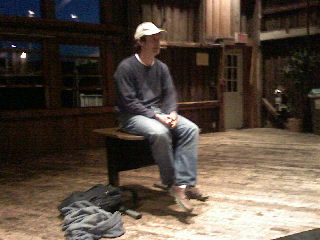
It's been and incredibly beautiful day out here in Western Mass--if there's one thing we have, it's beautiful days. Pandora founder Tim Westergren noticed this too...held a meet-up out here at a Hampshire College's Red Barn...
I'm only about 20 minutes away...how could I *not* go....and like everybody else who was there, I was incredibly interested to see what Tim would say about Pandora and the Music Genome Project (Tim was at SXSW Interactive this past March, too--but our paths didn't cross. I did sit in on his panel, which is where I got more interested in Pandora.)
It was great to have Tim out here--scanning his blog tonight, it's easy to see why he'd go to places like L.A. and New York. And he'll be out in Providence, RI on 10/4 for BIF-2, so it would make sense to hold a meetup there.
But out here in what's--technically, and in comparison to Boston--The Middle of Nowhere??
There were about 30 of us Pandora enthusiasts at the Red Barn, and by the questions people asked, everyone had a keen interest in music and a desire to know more about the genesis of the Music Genome Project....a mix of musicians, bloggers, student djs, a couple of reporters, and some curious folks. A good group.
Tim explained that Pandora's main focus is to help independent musicians, and he noted how Pandora takes submissions from "unsigned" bands and weaves them into the Genome--if the music passes a determination that it's of "quality." Now, quality might be a subjective judgment, but Pandora staff doesn't simply judge a piece of music after listening to it for three minutes. Rather, the staff of trained analysts who understand the various elements of music (folks *with* music degrees, who also go thru 150 hours of training by Pandora) listen to a piece of music for between 15 and 40 mins, to determine a piece of music's unique elements. It seemed that Tim was trying to explain that by considering these unique elements, one could determine that a piece of music had a certain kind of "quality."
Listening to Pandora, though, really isn't about tracking down the latest and greatest in Top 40, or the perfect tune; nor is it about being assaulted by all emo-and-garage all the time (that is, unless you program a station for that kind of music.) It's more about discovering new music that fits with music you already like...
Mostly everyone was interested to find out how the Genome works. As Tim explained, there are 400 unique music criteria. Voice alone can be described by over 30 different attributes! As mentioned, people with some expertise and training, listen to the music and mark it for the various criteria, which is then fed into the database. (it was explained how Surowiecki's "wisdom of crowds" idea doesn't quite work for the type of service they wanted to produce--music tastes are too broad to use that particular approach effectively.)
Every song has its own unique mathematical formula--it's own "genes."
Now, when a song or artist is picked out, the magic little computers search out other songs that reflect similarities in this mathematical formula....but it's not always going to pick the exact, perfect song. It needs feedback from us. Then, it becomes very necessary that we give the Genome a bit of feedback by rating a song "thumbs up" or "thumbs down." This way, the Genome can find more music that fits our particular likes and dislikes, not just what it scans and picks for us.
So, two "stations" of the same artist or song can be started at the same time, and each one end up totally different because of the "thumbs up" and "thumbs down" ranking process.
My Led Zeppelin and Ursula 1000 stations are, then, totally different from someone else's Led Zeppelin and Ursula 1000 stations....that is, if there's someone as particular in his/her tastes to also have Led Zep and Ursula 100 as their stations. (as I'm writing this, though, I've been listening to my White Stripes station...)
A funny thing, though, that some of us told Tim about, is that occasionally Pandora hiccups--basically, it can't find the next song in the Genome to play. While they're working on that *not* happeneing, Tim encouraged us to email them when it does. Feedback, after all, is super-important to the whole process.
Two very interesting factoids about Pandora: it grew by word-of-mouth and some props from Slashdot and other tech blogs. And they will never "play a song because someone paid us to." (gee, that beats ClearChannel all to hell...)
I often like to put Pandora to the test. I tend to have some very ecclectic music interests, which sometime befuddle the genome (I think). So, tonight, I entered "Vitas", that weird Russian tenor that looks like a baby Falco and sounds like the spawn of Klaus Nomi. Didn't come up with anything for "Vitas." Wasn't surprised there. So, I entered "Style Council"--Paul Weller's project *after* The Jam. I've come across few folks over the years--other than those who have been into music for as long as I have and were "punks" at one point or another--who know of Style Council. Yet, there they were, in Pandora (Mari Wilson, however, wasn't--but she's a contemporary of Style Council, seriously obscure and British and *very* retro in music style.) Although I'm finding with bands like Style Council, who were a bit tough to classify, that music that corresponds to its "genome" is stuff I really don't enjoy--like "Sweet Spot" from Captain Harry(?!?!eek!). It wasn't a very good fit with Style Council...
I was, though, very pleased with my Erasure station--just perfect for those "Oh! L'Amour!" moments ;-)
Come to think of it, Vitas might fit pretty well with Erasure...
Wednesday, September 27, 2006
Those Cheeky Comment-Spam Sploggin' Monkeys!
At some point or another, we all get zapped by spam comments. For some folks, spam comments come in at such a fast and furious rate (because they're programmed by bots) that they have to shut off their blog comments. When I started to notice spam comments coming in, I added word verification to the email notifications I already receive for blog comments.
The word verification seems to have slowed the nonsense down--but not stopped it. Now, the comment-spammer monkeys have taken it one cheeky step further. The comment I got this a.m. has been deleted from the entry where it appeared, but since I get email verification, I still have the text, left by one "NonToxic Chuck":
What makes this monkey possibly one of the cheekiest is that the comment seems to actually have a bit of thought. Even though Michelle Malkin's name is spelled wrong, that could be considered a common mistake, along with leaving the "s" off of "other" (for "others"). And the second paragraph alludes to iraqthemodel, which is a real conservative blogspot blog that's part of Pajamas Media.
NonToxic Chuck even has a profile (only 16 or so views though). So, at first glance, it appears that the comment is from a real live person.
Correction: real-life comment spammer who wants to lead us back to his splog.
There are two dead-giveaways that this is comment-spam from a splogger. First, the post was recorded on an entry from a year ago, that had absolutely nothing to do with the context of the comment. The post simply had the word "terrorism" in it, but nothing in the content of the post discusses political terrorism in relation to the war in Iraq or conservative politics--so the post was targeted by a bot.
All I could think was "Jeebus! ain't this rich."
The second key is in the word that is in bold in that paragraph, which, in the original text, was a hyperlink that lead to a splog. How did I know it was a splog? Well, it had one article, a reprint with a hyperlink to the original article, but no "about" page, and no links to other blogs. There were links to other pages but no content. What there was, aside from one article in very large print, were lots and lost of Google Adsense ads relating to anxiety relief.
Lots of ads with a bunch of content that's either cribbed from someone else or makes no sense is a sure sign of a splog.
What's the deal? Does this jerk think he's going to make good money off his splog? and how can we stop these idiots?
Sure, I could report them to Google Adsense, and I could flag the blog (as it was a blogspot blog.) But that seems to do virtually nothing.
So, not only is my content being stolen by sploggers, but I'm getting harassed by sploggers who think they're actually smart enough to leave comments that won't be taken for spam. Wow. Just like living in a bad neighborhood. And I don't even have to leave the house to get the flavor....
Update 9/27/06: Businessweek documents some of the major problems ofclickfraud spawned by splog
spam
splog
splogosphere
The word verification seems to have slowed the nonsense down--but not stopped it. Now, the comment-spammer monkeys have taken it one cheeky step further. The comment I got this a.m. has been deleted from the entry where it appeared, but since I get email verification, I still have the text, left by one "NonToxic Chuck":
I've had this same thought. I wonder about the Michell Malkins and other of the blogger world. Especially, those who blog about terrorist subjects. That would create a great deal of anxiety for me. They are very brave to tell the truth in their blogs.
One fellow, I think he was the webmaster at iraqthemodel (?) was killed. He was doing his blogging from Iraq.
What makes this monkey possibly one of the cheekiest is that the comment seems to actually have a bit of thought. Even though Michelle Malkin's name is spelled wrong, that could be considered a common mistake, along with leaving the "s" off of "other" (for "others"). And the second paragraph alludes to iraqthemodel, which is a real conservative blogspot blog that's part of Pajamas Media.
NonToxic Chuck even has a profile (only 16 or so views though). So, at first glance, it appears that the comment is from a real live person.
Correction: real-life comment spammer who wants to lead us back to his splog.
There are two dead-giveaways that this is comment-spam from a splogger. First, the post was recorded on an entry from a year ago, that had absolutely nothing to do with the context of the comment. The post simply had the word "terrorism" in it, but nothing in the content of the post discusses political terrorism in relation to the war in Iraq or conservative politics--so the post was targeted by a bot.
All I could think was "Jeebus! ain't this rich."
The second key is in the word that is in bold in that paragraph, which, in the original text, was a hyperlink that lead to a splog. How did I know it was a splog? Well, it had one article, a reprint with a hyperlink to the original article, but no "about" page, and no links to other blogs. There were links to other pages but no content. What there was, aside from one article in very large print, were lots and lost of Google Adsense ads relating to anxiety relief.
Lots of ads with a bunch of content that's either cribbed from someone else or makes no sense is a sure sign of a splog.
What's the deal? Does this jerk think he's going to make good money off his splog? and how can we stop these idiots?
Sure, I could report them to Google Adsense, and I could flag the blog (as it was a blogspot blog.) But that seems to do virtually nothing.
So, not only is my content being stolen by sploggers, but I'm getting harassed by sploggers who think they're actually smart enough to leave comments that won't be taken for spam. Wow. Just like living in a bad neighborhood. And I don't even have to leave the house to get the flavor....
Update 9/27/06: Businessweek documents some of the major problems ofclickfraud spawned by splog
spam
splog
splogosphere
Monday, September 25, 2006
Do Citizens Really Need "Gentle Expert Guidance" to Build a Better Online Encyclopedia? (or haven't we lost our virginity yet?)
UPDATE:10/19/06 Larry Sanger's changed the wording on his descrition of Citizendium! Okay, the use of "constables" in this version is kind of funny and makes one think of British bobbies, but Sanger is now acknowledging that this place we call the 'net has lots of intellectuals of various sort. His essay now says:
Bravo, Larry!
Catching up on things missed from vacation while catching up on the past week's silliness, I came across Nick Carr's commentary on Larry Sanger's new project Citizendium, which also links to a fabulous (and amusing) debate about Experts and Expertise between Clay Shirky (who starts it off here, with Sanger's retort and Shirky's rejoinder, yet both miss the following point I'm about to make....)
Essentially, Citizendium will be an "experimental new wiki project that combines public participation with gentle expert guidance," beginning its life as a "progressive fork" of Wikipedia...."But we expect it to take on a life of its own and, perhaps, to become the flagship of a new set of responsibly-managed free knowledge projects," sez Larry...
And get this tidbit:
Wow...I am shocked and awed. No, make that shocked and appalled that someone as intelligent as Sanger, who appears to want to build a community, would use such condescending language to try to reach, intelligent, thoughtful, articulate, educated Citizens, who, under different circumstances, might actually be his peers.
Now, I understand that Sanger's been a bit put off by the rough and tumble anarchy of Wikipedia, and seems to have some prejudices against online communities. He seems to desire to up the ante and the level of discourse as well as input into Citizendium
But, myself and a whole host of others could tell him that he ain't gonna get it by telling everyone he's going to have "experts" offer "gentle guidance."
Let's put it this way...an architect, who just might think of himself as an expert at building houses, who also sees himself as "regular people," may not find any desire to contribute to a place where "experts" will offer "gentle guidance."
He might not mind peer review, however.
And "gentle guidance"??? What are we, Sunday school kids trying to figure out what the whole bread-and-wine thing is all about?
Please, Larry...If you want the folks who constitute "regular people" on the 'net to be interested in your project, you're going to have to learn to speak to them at their level of intelligence...Which, quite frankly, is a lot higher than you may have been lead to believe from the level of discourse you perceive on forums, newsgroups, wikipedia, and some blogs. Remember, some of the smartest people are known for doing, and saying, very foolish things.
"will invite experts to serve as editors, who will be able to make content decisions in their areas of specialization, but otherwise working shoulder-to-shoulder with ordinary authors.
Bravo, Larry!
Catching up on things missed from vacation while catching up on the past week's silliness, I came across Nick Carr's commentary on Larry Sanger's new project Citizendium, which also links to a fabulous (and amusing) debate about Experts and Expertise between Clay Shirky (who starts it off here, with Sanger's retort and Shirky's rejoinder, yet both miss the following point I'm about to make....)
Essentially, Citizendium will be an "experimental new wiki project that combines public participation with gentle expert guidance," beginning its life as a "progressive fork" of Wikipedia...."But we expect it to take on a life of its own and, perhaps, to become the flagship of a new set of responsibly-managed free knowledge projects," sez Larry...
And get this tidbit:
We believe a fork is necessary, and justified, both to allow regular people a place to work under the direction of experts, and in which personal accountability--including the use of real names--is expected. In short, we want to create a responsible community and a good global citizen.
Wow...I am shocked and awed. No, make that shocked and appalled that someone as intelligent as Sanger, who appears to want to build a community, would use such condescending language to try to reach, intelligent, thoughtful, articulate, educated Citizens, who, under different circumstances, might actually be his peers.
Now, I understand that Sanger's been a bit put off by the rough and tumble anarchy of Wikipedia, and seems to have some prejudices against online communities. He seems to desire to up the ante and the level of discourse as well as input into Citizendium
But, myself and a whole host of others could tell him that he ain't gonna get it by telling everyone he's going to have "experts" offer "gentle guidance."
Let's put it this way...an architect, who just might think of himself as an expert at building houses, who also sees himself as "regular people," may not find any desire to contribute to a place where "experts" will offer "gentle guidance."
He might not mind peer review, however.
And "gentle guidance"??? What are we, Sunday school kids trying to figure out what the whole bread-and-wine thing is all about?
Please, Larry...If you want the folks who constitute "regular people" on the 'net to be interested in your project, you're going to have to learn to speak to them at their level of intelligence...Which, quite frankly, is a lot higher than you may have been lead to believe from the level of discourse you perceive on forums, newsgroups, wikipedia, and some blogs. Remember, some of the smartest people are known for doing, and saying, very foolish things.
Tuesday, September 19, 2006
Fox Filmed Entertainment and Fox Faith: Where "One Night With The King" has nothing to do with Elvis...
The LA Times reports this morning that News Corp's Fox Filmed Entertainment division will announce its plans to venture into old fashioned Christian Epic Filmmaking with its new Fox Faith Division. The Times mentions "Love's Abiding Joy," set for 10/6 release--but the film they *should* have mentioned is the gargantuan Christian romantic Epic One Night With the King, scheduled for release on Oct. 13
There are two trailers: the Macho Mainstream trailer:
And the longer, Schmaltzy Romantic trailer:
Isn't Peter O'Toole such a hambone?? Isn't Luke Goss a perfect dreamboat??? And what's with John Rhys-Davies in yet another epic film (at least in this one they don't squash him down to troll size)?
The film is produced by Gen8Xion Entertainment, in association with Fox Faith....the story is taken from the novel Hadassah:A Night With the King by travelling evangelist Tommy Tenney (who's also co-producer and reminds me a bit of Billy Sunday) and screenplay writer Mark Andrew Olsen.
Gener8Xion is headed by Matthew Crouch who was V.P. of the Trinity Broadcasting Network--which was started by Jim Bakker and is the home of the Preacher Lady With the Pink Hair and our favorite "healer", Benny Hinn.
The film even has a MySpace page
Check out what Tenney's Godchaser's site has to say about the film.
A quick synops: Tenney's taken the Story of Esther and christianized it--drawing in elements of good old fashioned Calvinist predestination and high romance into a very pragmatic story about a young woman who wins a beauty contest and wins the king's "favor" in order to save the Jewish people. Yes, there may have been some fateful hand of God in that Old Testament story, but I'm not so sure that Tenney's christianizing of the story, replete with a 20th century romantic ideals of kings and queens, reveals, as Tenney states, the "hidden truth of Esther's story."
So let's get a grip for a moment here. This is an Epic. It's a Movie. It is a resurrected form of filmmaking that passed away more than a generation ago. The film is made by individuals who have a particular intention for the story--whether that intention is moneymaking or something like proselytizing can only be determined by reading copious interviews of the filmmakers and script writers and producers (note: I have done extensive research on epic christian filmmaking, so yeah, I kind of know something about its mechanisms.)
Could their motive be simply to make a "family friendly film" about a girl who has the power to change the mind of a all-powerful ruler (basically by offering herself to him--oh, the story appears to leave out that the king has multiple wives)? Possible. As a student of both Media and Religion, I am Ultra-Skeptical of any film that purports to tell the truth about an event that happened several thousand years ago that is then sliced and diced and re-packaged for pop culture consumption. Distortions are going to be rife as filmmakers try to pluck just the right pop culture emotional notes that will get audiences into theaters and help studios turn a profit.
It is odd, though, that Epic films are making such a comeback after their slow demise over 40 years ago. The final collapse of the genre started in '63 with MGM's ultimate bank-breaking snooze-fest Cleopatra, continued through the George Stevens' biblically literal but culturally discordantThe Greatest Story Ever Told and that final nail-in-the-coffin, John Huston's creepy The Bible(1966). There were attempts at big 1930's style adventure films in the 1980's, most notably Raiders of the Lost Ark (John Rhys-Davies in his first ethnic epic role as the Egyptian Sallah) and the Star Wars Saga overlapping the 1970's and '80's...but these pale in comparison to the likes of Spartacus(actually a secular epic--Dalton Trumbo wrote the screenplay) and The Robe (which influenced the highly impressionable 8-year old mind of genius filmmaker Martin Scorsese.)
What isn't so odd is that these new epics, esp. the ones that are backed by Fox Faith and Gener8Xion Entertainment, are actually motivated by the same thing that motivated many of the old Hollywood epics--personal faith. Yet that faith of the 20th century was Mainstream Protestant (the guys who wrote Godspell), sometimes Episcopalean (Cecil B DeMille) or even Catholic (George Stevens), but was NOT high Evangelical/Petacostal. I wonder about the motivation of these new epic filmmakers. I know the motivation of the old epic filmmakers was not to proselytize, but can we say the same about these folks and their new epics?
And does Rupe Murdoch perhaps think that backing faith-based films will save his own immortal soul after what he hath wrought with MySpace?
Lots of questions--tons of kitsch--few answers--much to keep an eye on...
Update 10/8/06: The Unofficial Peter O'Toole Pages! has this to say. Can I get an "Amen, brother!"
Update 10/13/06 The reviews are rolling in...Dear Lord, why must Your most ardent followers unleash such bad movies in Your name? sez Josh Bell of Las Vegas Weekly
Journalism, citizen journalism, media,
There are two trailers: the Macho Mainstream trailer:
And the longer, Schmaltzy Romantic trailer:
Isn't Peter O'Toole such a hambone?? Isn't Luke Goss a perfect dreamboat??? And what's with John Rhys-Davies in yet another epic film (at least in this one they don't squash him down to troll size)?
The film is produced by Gen8Xion Entertainment, in association with Fox Faith....the story is taken from the novel Hadassah:A Night With the King by travelling evangelist Tommy Tenney (who's also co-producer and reminds me a bit of Billy Sunday) and screenplay writer Mark Andrew Olsen.
Gener8Xion is headed by Matthew Crouch who was V.P. of the Trinity Broadcasting Network--which was started by Jim Bakker and is the home of the Preacher Lady With the Pink Hair and our favorite "healer", Benny Hinn.
The film even has a MySpace page
Check out what Tenney's Godchaser's site has to say about the film.
A quick synops: Tenney's taken the Story of Esther and christianized it--drawing in elements of good old fashioned Calvinist predestination and high romance into a very pragmatic story about a young woman who wins a beauty contest and wins the king's "favor" in order to save the Jewish people. Yes, there may have been some fateful hand of God in that Old Testament story, but I'm not so sure that Tenney's christianizing of the story, replete with a 20th century romantic ideals of kings and queens, reveals, as Tenney states, the "hidden truth of Esther's story."
So let's get a grip for a moment here. This is an Epic. It's a Movie. It is a resurrected form of filmmaking that passed away more than a generation ago. The film is made by individuals who have a particular intention for the story--whether that intention is moneymaking or something like proselytizing can only be determined by reading copious interviews of the filmmakers and script writers and producers (note: I have done extensive research on epic christian filmmaking, so yeah, I kind of know something about its mechanisms.)
Could their motive be simply to make a "family friendly film" about a girl who has the power to change the mind of a all-powerful ruler (basically by offering herself to him--oh, the story appears to leave out that the king has multiple wives)? Possible. As a student of both Media and Religion, I am Ultra-Skeptical of any film that purports to tell the truth about an event that happened several thousand years ago that is then sliced and diced and re-packaged for pop culture consumption. Distortions are going to be rife as filmmakers try to pluck just the right pop culture emotional notes that will get audiences into theaters and help studios turn a profit.
It is odd, though, that Epic films are making such a comeback after their slow demise over 40 years ago. The final collapse of the genre started in '63 with MGM's ultimate bank-breaking snooze-fest Cleopatra, continued through the George Stevens' biblically literal but culturally discordantThe Greatest Story Ever Told and that final nail-in-the-coffin, John Huston's creepy The Bible(1966). There were attempts at big 1930's style adventure films in the 1980's, most notably Raiders of the Lost Ark (John Rhys-Davies in his first ethnic epic role as the Egyptian Sallah) and the Star Wars Saga overlapping the 1970's and '80's...but these pale in comparison to the likes of Spartacus(actually a secular epic--Dalton Trumbo wrote the screenplay) and The Robe (which influenced the highly impressionable 8-year old mind of genius filmmaker Martin Scorsese.)
What isn't so odd is that these new epics, esp. the ones that are backed by Fox Faith and Gener8Xion Entertainment, are actually motivated by the same thing that motivated many of the old Hollywood epics--personal faith. Yet that faith of the 20th century was Mainstream Protestant (the guys who wrote Godspell), sometimes Episcopalean (Cecil B DeMille) or even Catholic (George Stevens), but was NOT high Evangelical/Petacostal. I wonder about the motivation of these new epic filmmakers. I know the motivation of the old epic filmmakers was not to proselytize, but can we say the same about these folks and their new epics?
And does Rupe Murdoch perhaps think that backing faith-based films will save his own immortal soul after what he hath wrought with MySpace?
Lots of questions--tons of kitsch--few answers--much to keep an eye on...
Update 10/8/06: The Unofficial Peter O'Toole Pages! has this to say. Can I get an "Amen, brother!"
Update 10/13/06 The reviews are rolling in...Dear Lord, why must Your most ardent followers unleash such bad movies in Your name? sez Josh Bell of Las Vegas Weekly
Journalism, citizen journalism, media,
Monday, September 18, 2006
Is Google Really Just One Big Splog??
Think about this: Okay, you're the Belgian Association of News Editors. And you've noticed that Google's been aggregating the content of all your newspapers and not paying them one red Euro for it. What happens next? You lodge a complaint in the Belgian Courts against Google who then find that:
So there.
But, if you think about it, isn't that kind of what sploggers do--take your content, republish it, not tell you, then make money off of it?
Think about it....
Update: Google drops Belgian news...oh, well...guess all their spare change is going towards paying the AP.
Update 9/24/06 Steve Yelvington dissects the Belgian Court decision....one of Steve's points:
Oh, and let's remember folks: Google is not a public library, and its collecting of content may not be for quite the same reasons as that of a public library.
Journalism, citizen journalism, media newspapers
If Google doesn't comply with this month's ruling and continues to publish Belgian newspaper copy without permission and without paying a fee, the Belgian Court of First Instance will fine the company €1 million ($1.27 million) daily, the association said. "It's an infraction of Belgian and EU laws, the newspapers are losing money this way and, above all, Google thinks it is outside the law," the association's Secretary-General Margaret Boribon said.
So there.
But, if you think about it, isn't that kind of what sploggers do--take your content, republish it, not tell you, then make money off of it?
Think about it....
Update: Google drops Belgian news...oh, well...guess all their spare change is going towards paying the AP.
Update 9/24/06 Steve Yelvington dissects the Belgian Court decision....one of Steve's points:
Google is sending valuable traffic to publishers, and squaring off against Google is self-destructive. This is not relevant to the question of whether Google's repurposing practices amount to fair use or thievery. But it also isn't automatically true. Publishers benefit from some sorts of Google listings and not from others. Many publishers have a business model predicated entirely on service to a geographically focused community and derive little benefit (and often great expense) from Google-driven traffic. And, of course, publishers suffer when the new summary pages of Google News take away the audience that otherwise would have gone to the publishers' content on their own sites.It appears that, as I thought, the argument the Belgian papers have is not with aggregating a few lines, but with the article's storage on Google. Once an article is "cached" in Google, that it remains in Google, and that readers never get to the site where the article originally appeared. In this particular sense, not in the sense of aggregating a few lines and then sending traffic to the newspaper's site via a link, Google is indeed acting like a splog. They're holding the content and making money from it in perpetuity. not cool, Google, not cool. Steve concludes: "I'm not eager to see lawsuits against search engines as a primary tool for resolving this issue, but it seems to me that the Belgian ruling is well grounded in the reality of today's Internet. There is a line between fair use and thievery, and it is not Google's to define through unilateral action."
Oh, and let's remember folks: Google is not a public library, and its collecting of content may not be for quite the same reasons as that of a public library.
Journalism, citizen journalism, media newspapers
Susan Estrich writes for Fox News: Can Newspapers Do Good Journalism And Make Money?
Does anyone other than me see an immense irony in this??
Does anyone other than me see an immense irony in this??

Monday, September 11, 2006
Tuesday, September 05, 2006
Silly Sock Puppetry Roasts Reputation of Lee Siegel
File under What Didn't You Learn From Michael Hiltzik Dept: Lee Siegel has been summarily dismissed from the New Republic for engaging in sock puppetry. The NYTimes illuminates the sad scenario of Journalist Gone Wrong:
Siegel calls what he did "a prank." Which seems to illuminate even further the disdain that many journalists have for the blogosphere and the people who choose to interact within it. Kos has some spectacular comments on the removal of the sock.
Franklin Foer, the New Republic’s editor, said in an interview that he first became aware of the accusations against Mr. Siegel on Thursday afternoon, after a colleague noticed a comment in the Talkback section of Mr. Siegel’s blog that accused him of using the alias “sprezzatura” to defend his articles and assail his critics.
That comment, posted by a reader named “jhschwartz” on Aug. 27, said that “sprezzatura appears only to weigh in on TNR forums to admonish and taunt posters who dislike Lee Siegel” before concluding, “I would say with 99% confidence that ‘sprezzatura’ is a Siegel alias.”
“We launched an investigation,” Mr. Foer said. He added that he was confident that sprezzatura’s posts were written with Mr. Siegel’s “full cooperation,” but declined to say whether the alias was used by Mr. Siegel himself because the affair was still under investigation. “As soon as the facts of the case became clear to me on Friday, we closed down the blog and made an announcement.” Mr. Foer said that while he liked to see blog posts before they were published, Mr. Siegel did not have an editor assigned to his blog entries.
Siegel calls what he did "a prank." Which seems to illuminate even further the disdain that many journalists have for the blogosphere and the people who choose to interact within it. Kos has some spectacular comments on the removal of the sock.
Friday, September 01, 2006
So Many Splogs, So Little Time
The Head Lemur has *so* had it with a particular splogger that he decided to take extreme yet highly appropriate action to deal with him....
And mangaged to get him shut him down...
Interestingly, the splogger responded and basically explained he was trying to set up an aggregator and had sent emails to all of the people he wanted to aggregate. I'm not sure I totally buy it, esp. considering the folks who've said they never received email from the guy (see THL's post for the names).
THL's final words on the matter are here Lemur found the guy, they have exchanged emails--the guy will not use THL's content.
The way the splogger-in-question was aggregating was a bit different from when I first found Topix.net aggregating my content. There was no "contrubted by" line, which gives the impression that permission was given and the content was contributed. Topix looked like an aggregator and only grabbed part of my feed, according to a certain search criteria, so it was very clear it was only an aggregator.
However, I know there are other splogs that have no contact info and are probably super-hard to track down. If any of y'all are interested in finding who's been splogging you, do an IceRocket.com blogsearch of your url. IR seems to find sploggers much quicker/better than Technorati.
What we do next, though, I have no idea....
This is a great outcome, but doesn't totally solve the problem of splogs that have no contact information.
spam
splog
splogosphere
And mangaged to get him shut him down...
Interestingly, the splogger responded and basically explained he was trying to set up an aggregator and had sent emails to all of the people he wanted to aggregate. I'm not sure I totally buy it, esp. considering the folks who've said they never received email from the guy (see THL's post for the names).
THL's final words on the matter are here Lemur found the guy, they have exchanged emails--the guy will not use THL's content.
The way the splogger-in-question was aggregating was a bit different from when I first found Topix.net aggregating my content. There was no "contrubted by" line, which gives the impression that permission was given and the content was contributed. Topix looked like an aggregator and only grabbed part of my feed, according to a certain search criteria, so it was very clear it was only an aggregator.
However, I know there are other splogs that have no contact info and are probably super-hard to track down. If any of y'all are interested in finding who's been splogging you, do an IceRocket.com blogsearch of your url. IR seems to find sploggers much quicker/better than Technorati.
What we do next, though, I have no idea....
This is a great outcome, but doesn't totally solve the problem of splogs that have no contact information.
spam
splog
splogosphere
Wednesday, August 30, 2006
Oh, great! Now everybody's a freakin' media critic!
National Journal media critic Bill Powers is interviewed in PRWeek on the state of media criticism and what PRWeek sees as the burgeoning number of media critics:
I've emailed Bill a couple of times on his column, and he's always responded. great guy who actually knows something about the blogosphere. But one thing Bill is missing is an understanding of why people do media criticism. Think of it this way, Bill: when folks grow up with tv, radio, movies, and all sorts of media, and they're not lulled into brain-deadness from the unbiquity of celebrity worship, they're going to form opinions about media. And, unlike their fathers, who spent countless hours yelling at Walter Cronkite, most folks nowadays are going to channel all that pent up frustration into some darned astute writing and are going to use that writing to talk back to the Powers that Be in media. Most of us who are doing it are smart, perceptive and even might have written on media in the past or created it at some time in our lives (yes, to blow my own horn again: I did an honors thesis that combined media and religion.)
We're a whole new level of media critic and darned proud of it.
Journalism, citizen journalism, media, Blogging
PRWeek: With the Web, now almost anybody can be a media critic. Do you think the quality of media criticism is still there?
Bill Powers: Suddenly, there are about 10 million more media critics than there were 10 years ago. I find that exciting. It's funny, there are all these bloggers and all these people who are instant media critics, and yet there are a lot of traditional news outlets that still don't have anyone doing media criticism... My philosophy is, the more, the merrier.
And I actually think there are a lot of bloggers who are so good at it that I sort of wish they would be picked up by mainstream outlets and do both. Because I just think it's a topic that's really inexhaustible. I do this weekly column and I never have a shortage of ideas. There is always so much happening. And I do find that people really are engaged by this subject and talk about it. I think the conventional wisdom in journalism is that media criticism is an inside-the-business topic and it's really just going to be read by other journalists. And I don't think that's true anymore. I think there is a broader interest. Everybody sort of becomes a media critic, and people follow the stuff. I just did a public appearance last night jointly with Dan Okrent, the former New York Times ombudsman. It was a charity thing for a public library, and they had us in a congregational church in a town up where I live. All these hundreds of people showed up! It was great. They were all interested, and they asked incredibly intelligent questions, it was just fascinating. It wasn't journalists, it was people from the public who really follow this stuff and care about journalism.
I've emailed Bill a couple of times on his column, and he's always responded. great guy who actually knows something about the blogosphere. But one thing Bill is missing is an understanding of why people do media criticism. Think of it this way, Bill: when folks grow up with tv, radio, movies, and all sorts of media, and they're not lulled into brain-deadness from the unbiquity of celebrity worship, they're going to form opinions about media. And, unlike their fathers, who spent countless hours yelling at Walter Cronkite, most folks nowadays are going to channel all that pent up frustration into some darned astute writing and are going to use that writing to talk back to the Powers that Be in media. Most of us who are doing it are smart, perceptive and even might have written on media in the past or created it at some time in our lives (yes, to blow my own horn again: I did an honors thesis that combined media and religion.)
We're a whole new level of media critic and darned proud of it.
Journalism, citizen journalism, media, Blogging
Can MSM Do Citizen Journalism Without Acting Like Big Momma?
Like the domineering mother of a precocious child, the MSM is implementing all sorts of plans to help The People become citizen journalists....
By now, everyone has heard thatCNN jumped on the citizen journalism bandwagon and seeks video, audio, photographic content for their newscasts.
Perhaps, though, there's a difference between citizen-generated content and citizen journalism...but to differentiate would be less of a selling point. After all citizen journalism is a really wonderful buzzword and it'll make CNN look really, really hip to include The People in its efforts.
The World Company, which publishes the Lawrenced Journal-World, along with Kansas University's William Allen White School of Journalism and Mass Communications is launching a citizen journalism academy where they'll even teach blogging! That's kind of funny, considering the blogosphere is a mystery to many at all different levels of MSM. The J-W's efforts appear sincere, but are they looking to cultivate independent thinking in their citizen journalists? or is it more about cultivating a select group of unpaid stringers?
What gets me in all these experiments is that no one is thinking that maybe, just maybe, The People should be watchdogging the MSM on every level--from the local paper to big media outlets. I wonder how much their desire to incorporate citizens is really a desire to stop the watchdogging and get some cheap labor in the process? There's been talk of outsourcing some journalism jobs to India, but when the media can get The People to do its job for nothing by catering to their sense of civic duty, why even outsource?
Journalism, citizen journalism, media, Blogging, Blog, Blogs,
By now, everyone has heard thatCNN jumped on the citizen journalism bandwagon and seeks video, audio, photographic content for their newscasts.
Perhaps, though, there's a difference between citizen-generated content and citizen journalism...but to differentiate would be less of a selling point. After all citizen journalism is a really wonderful buzzword and it'll make CNN look really, really hip to include The People in its efforts.
The World Company, which publishes the Lawrenced Journal-World, along with Kansas University's William Allen White School of Journalism and Mass Communications is launching a citizen journalism academy where they'll even teach blogging! That's kind of funny, considering the blogosphere is a mystery to many at all different levels of MSM. The J-W's efforts appear sincere, but are they looking to cultivate independent thinking in their citizen journalists? or is it more about cultivating a select group of unpaid stringers?
What gets me in all these experiments is that no one is thinking that maybe, just maybe, The People should be watchdogging the MSM on every level--from the local paper to big media outlets. I wonder how much their desire to incorporate citizens is really a desire to stop the watchdogging and get some cheap labor in the process? There's been talk of outsourcing some journalism jobs to India, but when the media can get The People to do its job for nothing by catering to their sense of civic duty, why even outsource?
Journalism, citizen journalism, media, Blogging, Blog, Blogs,
Subscribe to:
Posts (Atom)